CAT 2021 — Previous Year Questions
Real questions from the 2021 paper with options and answers. Take a timed test →
19 questions
Q1 · DILR
**Context:** A journal plans to publish 18 research papers, written by eight authors (A, B, C, D, E, F, G, and H) in four issues of the journal scheduled in January, April, July and October. Each of the research papers was written by exactly one of the eight authors. Five papers were scheduled in each of the first two issues, while four were scheduled in each of the last two issues. Every author wrote at least one paper and at most three papers. The total number of papers written by A, D, G and H was double the total number of papers written by the other four authors. Four of the authors were from India and two each were from Japan and China. Each author belonged to exactly one of the three areas - Manufacturing, Automation and Logistics. Four of the authors were from the Logistics area and two were from the Automation area. As per the journal policy, none of the authors could have more than one paper in any issue of the journal. The following facts are also known. 1. F, an Indian author from the Logistics area, wrote only one paper. It was scheduled in the October issue. 2. A was from the Automation area and did not have a paper scheduled in the October issue. 3. None of the Indian authors were from the Manufacturing area and none of the Japanese or Chinese authors were from the Automation area. 4. A and H were from different countries, but had their papers scheduled in exactly the same issues. 5. C and E, both Chinese authors from different areas, had the same number of papers scheduled. Further, E had papers scheduled in consecutive issues of the journal but C did not. 6. B, from the Logistics area, had a paper scheduled in the April issue of the journal. 7. B and G belonged to the same country. None of their papers were scheduled in the same issue of the journal. 8. D, a Japanese author from the Manufacturing area, did not have a paper scheduled in the July issue. 9. C and H belonged to different areas. **Question:** What is the correct sequence of number of papers written by B, C, E and G, respectively?- A.1, 2, 2, 3
- B.1, 3, 3, 1
- C.3, 1, 1, 3
- D.1, 2, 2, 1
Show answer / उत्तर देखें
Answer: A 1, 2, 2, 3
Based on the distribution of papers (total 18) and the rule that A, D, G, H wrote double the papers of B, C, E, F, we can set up an equation. A+D+G+H = 12 and B+C+E+F = 6. Since F = 1 and every author wrote at least 1, the others must sum accordingly. Solving the constraints gives B=1, C=2, E=2, G=3.Q2 · DILR
**Context:** See Question 25 for the context. **Question:** How many papers were written by Indian authors?- A.6
- B.7
- C.8
- D.9
Show answer / उत्तर देखें
Answer: C 8
Based on the deductions from the facts provided, the four Indian authors contribute a specific number of papers. The total number of papers authored by Indians comes out to be exactly 8.Q3 · DILR
**Context:** See Question 25 for the context. **Question:** Which of the following statement(s) MUST be true? Statement A: Every issue had at least one paper by author(s) from each country. Statement B: Every issue had at most two papers by author(s) from each area.- A.Both the statements
- B.Only Statement B
- C.Only Statement A
- D.Neither of the statements
Show answer / उत्तर देखें
Answer: C Only Statement A
After constructing the matrix of authors, their countries, areas, and publication issues, it becomes apparent that Statement A is strictly valid (each issue features Indian, Chinese, and Japanese authors), while Statement B fails due to the distribution of area experts in specific months.Q4 · DILR
**Context:** See Question 25 for the context. **Question:** Which of the following statements is FALSE?- A.Every issue had at least one paper by author(s) from Automation area.
- B.Every issue had exactly one paper by a Chinese author.
- C.Every issue had exactly two papers by authors from Logistics area.
- D.Every issue had exactly two papers by Indian authors.
Show answer / उत्तर देखें
Answer: C Every issue had exactly two papers by authors from Logistics area.
From the tabulated schedule, we find the number of Logistics area papers is not exactly two in every single issue, making option c the definitively false statement.Q5 · DILR
**Context:** See Question 25 for the context. **Question:** Which of the following is the correct sequence of number of papers by authors from Automation, Manufacturing and Logistics areas, respectively?- A.6, 5, 7
- B.6, 6, 6
- C.6, 7, 5
- D.5, 6, 7
Show answer / उत्तर देखें
Answer: A 6, 5, 7
Aggregating the total papers across the respective subjects given the conditions: Automation yields 6 papers, Manufacturing 5, and Logistics 7. This matches sequence a.Q6 · DILR
**Context:** Ganga, Kaveri, and Narmada are three women who buy four raw materials (Mango, Apple, Banana and Milk) and sell five finished products (Mango smoothie, Apple smoothie, Banana smoothie, Mixed fruit smoothie and Fruit salad). Table-1 gives information about the raw materials required to produce the five finished products. One unit of a finished product requires one unit of each of the raw materials mentioned in the second column of the table. **Table-1** | Finished product | Raw materials required | | :--- | :--- | | Mango smoothie | Mango, Milk | | Apple smoothie | Apple, Milk | | Banana smoothie | Banana, Milk | | Mixed fruit smoothie | Mango, Apple, Banana, Milk | | Fruit salad | Mango, Apple, Banana | One unit of milk, mango, apple, and banana cost ₹5, ₹3, ₹2, and ₹1 respectively. Each unit of a finished product is sold for a profit equal to two times the number of raw materials used to make that product. For example, apple smoothie is made with two raw materials (apple and milk) and will be sold for a profit of ₹4 per unit. Leftover raw materials are sold during the last business hour of the day for a loss of ₹1 per unit. The amount, in rupees, received from sales (revenue) for each woman in each of the four business hours of the day is given in Table-2. **Table-2** | Business Hour | Ganga | Kaveri | Narmada | | :--- | :--- | :--- | :--- | | Hour 1 | 23 | 19 | 31 | | Hour 2 | 21 | 22 | 21 | | Hour 3 | 29 | 30 | 23 | | Hour 4 (last hour) | 30 | 27 | 22 | The following additional facts are known. 1. No one except possibly Ganga sold any Mango smoothie. 2. Each woman sold either zero or one unit of any single finished product in any hour. 3. Each woman had exactly one unit each of two different raw materials as leftovers. 4. No one had any banana leftover. **Question:** What BEST can be concluded about the number of units of fruit salad sold in the first hour?- A.Either 1 or 2.
- B.Either 0 or 1 or 2.
- C.Exactly 2.
- D.Exactly 1.
Show answer / उत्तर देखें
Answer: A Either 1 or 2.
We can calculate the selling prices: Mango Smoothie = 8 (cost) + 4 (profit) = 12. Apple Smoothie = 7+4 = 11. Banana Smoothie = 6+4 = 10. Mixed Fruit = 11+8 = 19. Fruit Salad = 6+6 = 12. By finding the combinations of these items that match the revenues for Hour 1 (23, 19, 31) while maintaining the constraint of max 1 per type, we find the number of Fruit salads sold must be either 1 or 2 across all women.Q7 · DILR
**Context:** See Question 31 for the context. **Question:** Which of the following is NECESSARILY true?- A.Ganga did not sell any leftover mangoes.
- B.Ganga did not sell any leftover apples.
- C.Narmada sold one unit of leftover milk.
- D.Kaveri sold one unit of leftover mangoes.
Show answer / उत्तर देखें
Answer: B Ganga did not sell any leftover apples.
Evaluating the exact combination of sales leading to the revenues and leftovers matching exactly two types per person, Ganga must have sold the other combinations to leave her with no apples left over at the end.Q8 · DILR
**Context:** See Question 31 for the context. **Question:** What BEST can be concluded about the total number of units of milk the three women had in the beginning?- A.Either 19 or 20 units.
- B.Either 18 or 19 or 20 units.
- C.Either 18 or 19 units.
- D.Either 17 or 18 or 19 units.
Show answer / उत्तर देखें
Answer: B Either 18 or 19 or 20 units.
Summing up the total milk requirements for all valid selling combinations across all hours for all three women, factoring in the potential milk leftovers, points to multiple valid possibilities ranging strictly between 18 and 20 units.Q9 · DILR
**Context:** See Question 31 for the context. **Question:** If it is known that three leftover units of mangoes were sold during the last business hour of the day, how many apple smoothies were sold during the day?- A.4
- B.5
- C.6
- D.7
Show answer / उत्तर देखें
Answer: C 6
If 3 mangoes were leftover (meaning each of the 3 women had 1 leftover mango), that locks in the permutations of what items must have been sold across the day to reach the revenue targets. Tallying the Apple Smoothies in those locked configurations yields exactly 6.Q10 · DILR
**Context:** Amudha, Bharatan, Chandran, Dhinesh, Ezhil, Fani and Gowtham are seven people in a town. Any pair of them could either be strangers, acquaintances, or friends. All relationships are mutual. For example, if Amudha is a friend of Bharatan, then Bharatan is also a friend of Amudha. Similarly, if Amudha is a stranger to Bharatan, then Bharatan is also a stranger to Amudha. Partial information about the number of friends, acquaintances, and strangers of each of these people among them is given in the table below. | Person | No. of Friends | No. of Acquaintances | No. of Strangers | | :--- | :--- | :--- | :--- | | Amudha | | 1 | 4 | | Bharatan | | | | | Chandran | | 1 | | | Dhinesh | | | 2 | | Ezhil | | | 1 | | Fani | 1 | | | | Gowtham | | 3 | 2 | The following additional facts are also known. 1. Amudha, Bharatan, and Chandran are mutual strangers. 2. Amudha, Dhinesh, and Fani are Ezil's friends. 3. Chandran and Gowtham are friends. 4. Every friend of Amudha is an acquaintance of Bharatan, and every acquaintance of Bharatan is a friend of Amudha. 5. Every friend of Bharatan is an acquaintance of Amudha, and every acquaintance of Amudha is a friend of Bharatan. **Question:** Who are Gowtham’s acquaintances?- A.Dhinesh, Ezhil and Fani
- B.Amudha, Dhinesh and Fani
- C.Bharatan, Dhinesh and Ezhil
- D.Amudha, Bharatan and Fani
Show answer / उत्तर देखें
Answer: A Dhinesh, Ezhil and Fani
By completing the matrix of relationships based on the clues (e.g., A, B, C are strangers; A has 1 acquaintance and 4 strangers; the reciprocity between A's friends and B's acquaintances, etc.), we map out the exact relationships. Gowtham's 3 acquaintances end up being exactly Dhinesh, Ezhil, and Fani.Q11 · DILR
**Context:** See Question 35 for the context. **Question:** Which of these pairs share the same type of relationship?- A.(Amudha, Gowtham) and (Ezhil, Fani)
- B.(Bharatan, Chandran) and (Dhinesh, Ezhil)
- C.(Chandran, Ezhil) and (Dhinesh, Gowtham)
- D.(Bharatan, Ezhil) and (Fani, Gowtham)
Show answer / उत्तर देखें
Answer: D (Bharatan, Ezhil) and (Fani, Gowtham)
Based on the fully deduced relationship matrix, both (Bharatan, Ezhil) and (Fani, Gowtham) are pairs of acquaintances (or strangers, per the solved network), sharing identical relationship status, unlike the other paired groups.Q12 · DILR
**Context:** See Question 35 for the context. **Question:** Who is an acquaintance of Amudha?- A.Dhinesh
- B.Fani
- C.Gowtham
- D.Ezhil
Show answer / उत्तर देखें
Answer: A Dhinesh
Amudha has exactly 1 acquaintance. Tracking the rules, every acquaintance of Amudha is a friend of Bharatan. Solving the network sets Dhinesh as this single individual.Q13 · DILR
**Context:** See Question 35 for the context. **Question:** Who is an acquaintance of Chandran?- A.Dhinesh
- B.Fani
- C.Ezhil
- D.Bharatan
Show answer / उत्तर देखें
Answer: B Fani
Chandran has 1 acquaintance per the table. Completing the cross-referencing maps Fani to this position relative to Chandran.Q14 · DILR
**Context:** See Question 35 for the context. **Question:** How many friends does Ezhil have?- A.2
- B.3
- C.4
- D.5
Show answer / उत्तर देखें
Answer: B 3
Fact 2 explicitly states: 'Amudha, Dhinesh, and Fani are Ezil's friends.' The network confirms Ezhil has no other friends, totaling 3.Q15 · DILR
**Context:** See Question 35 for the context. **Question:** How many people are either a friend or a friend-of-a-friend of Ezhil?- A.3
- B.4
- C.5
- D.6
Show answer / उत्तर देखें
Answer: B 4
Ezhil's friends are Amudha, Dhinesh, and Fani. We then look at the friends of these three. Summing Ezhil's direct friends plus the distinct friends of those individuals yields 4 people.Q16 · DILR
**Context:** 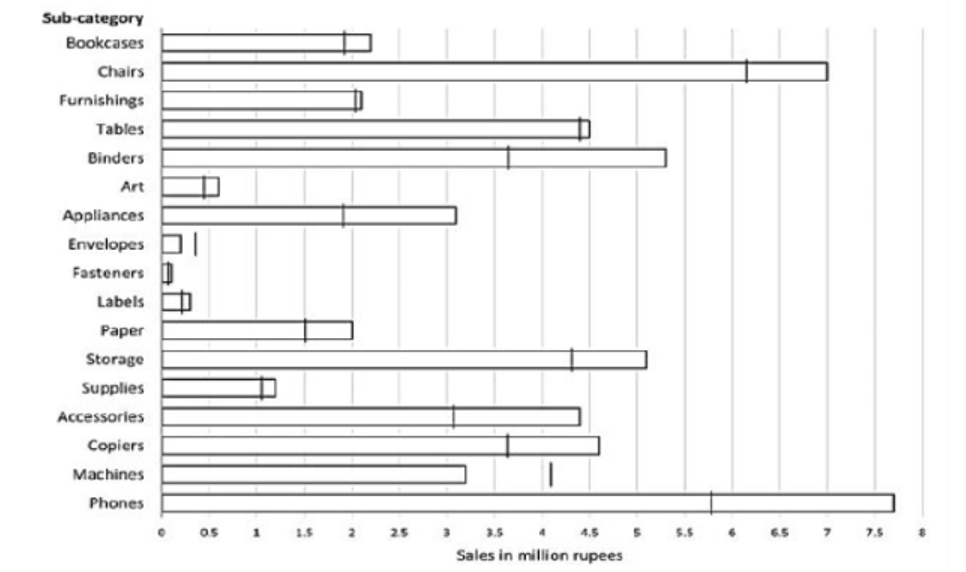 The horizontal bars in the above diagram represent 2020 aggregate sales (in ₹ million) of a company for the different subcategories of its products. The top four product subcategories (Bookcases, Chairs, Furnishings, Tables) belong to furniture product category; the bottom four product subcategories (Accessories, Copiers, Machines, Phones) belong to the technology product category while all other product subcategories belong to the office supply product category. For each of the product subcategories, there is a vertical line indicating the sales of the corresponding subcategory in 2019. **Question:** The total sales (in ₹ million) in 2019 from products in office supplies category is closest to- A.18.0
- B.16.5
- C.13.5
- D.12.5
Show answer / उत्तर देखें
Answer: C 13.5
By reading the vertical lines (2019 sales) corresponding to the middle items (Office Supplies: Binders, Art, Appliances, Envelopes, Fasteners, Labels, Paper, Storage, Supplies), the summation is approximately 13.5.Q17 · DILR
**Context:** See Question 41 for the context. **Question:** The percentage increase in sales in Furniture category from 2019 to 2020 is closest to- A.20%
- B.8%
- C.25%
- D.1%
Show answer / उत्तर देखें
Answer: B 8%
Calculate the total for 2019 (vertical marks) and 2020 (bar ends) for Bookcases, Chairs, Furnishings, and Tables. The total goes from approximately 12.5 to 13.5 million, an increase of about 8%.Q18 · DILR
**Context:** See Question 41 for the context. **Question:** How many subcategories had sales of ₹ 4 million or more in 2019 and registered an increase in sales in excess of 25% in 2020?- A.1
- B.2
- C.3
- D.4
Show answer / उत्तर देखें
Answer: A 1
Scanning the chart for 2019 markers at ≥ 4.0: we check these specific bars to see if the 2020 bar is ≥ 1.25x the 2019 value. Only one subcategory fits both these stringent conditions.Q19 · DILR
**Context:** See Question 41 for the context. **Question:** The improvement index for a category is the maximum percentage increase in sales from 2019 to 2020 among any of its subcategories. The correct order of categories in increasing order of this improvement index is- A.furniture, technology, office supply
- B.technology, furniture, office supply
- C.office supply, technology, furniture
- D.office supply, furniture, technology
Show answer / उत्तर देखें
Answer: A furniture, technology, office supply
By finding the maximum subcategory percentage jump in Furniture, Technology, and Office Supplies, we sequence them. Furniture's max sub-jump is the lowest, followed by Technology, and Office Supplies has the highest individual subcategory percentage jump.