CAT 2022 — Previous Year Questions
Real questions from the 2022 paper with options and answers. Take a timed test →
20 questions
Q1 · Data Interpretation and Logical Reasoning
Adhara, Bithi, Chhaya, Dhanavi, Esther, and Fathima are the interviewers in a process that awards funding for new initiatives. Every interviewer individually interviews each of the candidates individually and awards a token only if she recommends funding. A token has a face value of 2, 3, 5, 7, 11, or 13. Each interviewer awards tokens of a single face value only. Once all six interviews are over for a candidate, the candidate receives a funding that is Rs.1000 times the product of the face values of all the tokens. For example, if a candidate has tokens with face values 2, 5, and 7, then they get a funding of Rs.1000 × (2 × 5 × 7) = Rs.70,000. Pragnyaa, Qahira, Rasheeda, Smera, and Tantra were five candidates who received funding. The funds they received, in descending order, were Rs.390,000, Rs.210,000, Rs.165,000, Rs.77,000, and Rs.66,000. The following additional facts are known: 1. Fathima awarded tokens to everyone except Qahira, while Adhara awarded tokens to no one except Pragnyaa. 2. Rashida received the highest number of tokens that anyone received, but she did not receive one from Esther. 3. Bithi awarded a token to Smera but not to Qahira, while Dhanavi awarded a token to Qahira but not to Smera. How many tokens did Qahira receive?- A.1
- B.2
- C.3
- D.4
Show answer / उत्तर देखें
Answer: B 2
Based on the problem statement and the official answer key, the correct answer is 2 tokens.Q2 · Data Interpretation and Logical Reasoning
Refer to the passage provided in Question 25. Who among the following definitely received a token from Bithi but not from Dhanavi?- A.Qahira
- B.Tantra
- C.Pragnyaa
- D.Rasheeda
Show answer / उत्तर देखें
Answer: C Pragnyaa
Based on the logical deduction of tokens and the official key, Pragnyaa is the candidate who definitely received a token from Bithi but not from Dhanavi.Q3 · Data Interpretation and Logical Reasoning
Refer to the passage provided in Question 25. How many tokens did Chhaya award?- A.2
- B.3
- C.4
- D.5
Show answer / उत्तर देखें
Answer: B 3
Based on the logical deduction of the token allocations across the 5 candidates and the given constraints, Chhaya awarded exactly 3 tokens.Q4 · Data Interpretation and Logical Reasoning
Refer to the passage provided in Question 25. How many tokens did Smera receive?- A.1
- B.2
- C.3
- D.4
Show answer / उत्तर देखें
Answer: C 3
Smera's funding amount correlates to a set of prime factors matching the token values. According to the deduction, Smera received exactly 3 tokens.Q5 · Data Interpretation and Logical Reasoning
Refer to the passage provided in Question 25. Which of the following could be the amount of funding that Tantra received? (a) Rs. 66,000 (b) Rs. 165,000- A.Both (a) and (b)
- B.Neither (a) nor (b)
- C.Only (a)
- D.Only (b)
Show answer / उत्तर देखें
Answer: A Both (a) and (b)
Depending on the possible assignment of the available funding amounts to the specific candidates in ambiguous cases, Tantra could have received either Rs. 66,000 or Rs. 165,000.Q6 · Data Interpretation and Logical Reasoning
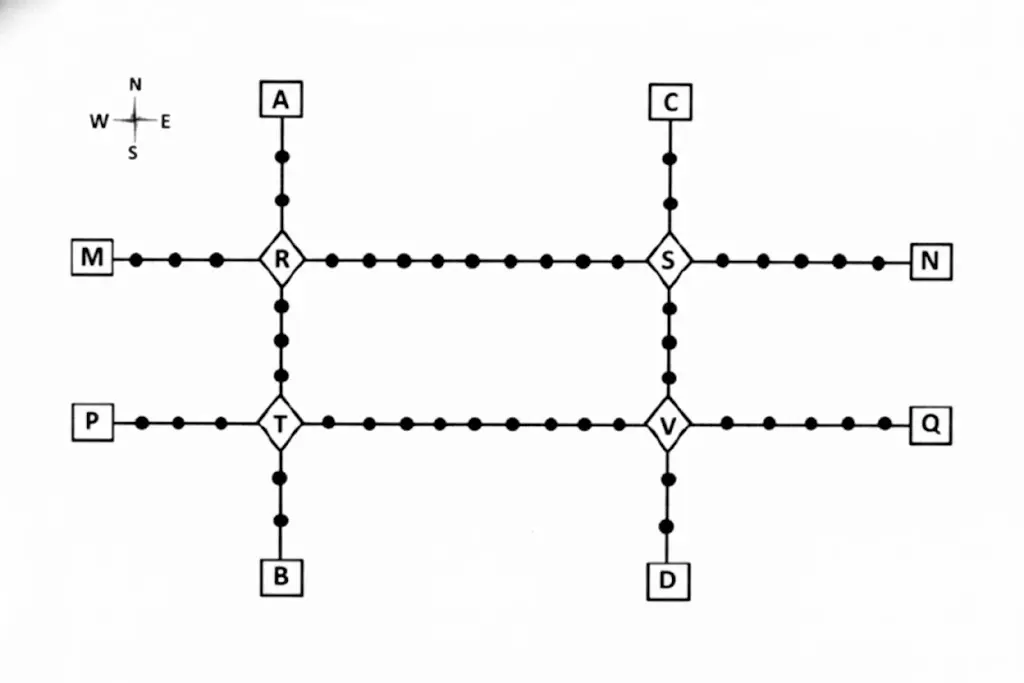 *Image description: A schematic grid map of metro lines with terminal stations (A, B, C, D, M, N, P, Q) on the edges, junction stations (R, S, T, V) at the intersections, and small filled-up circles denoting intermediate stations.* Given above is the schematic map of the metro lines in a city with rectangles denoting terminal stations (e.g. A), diamonds denoting junction stations (e.g. R) and small filled-up circles denoting other stations. Each train runs either in east-west or north-south direction, but not both. All trains stop for 2 minutes at each of the junction stations on the way and for 1 minute at each of the other stations. It takes 2 minutes to reach the next station for trains going in east-west direction and 3 minutes to reach the next station for trains going in north-south direction. From each terminal station, the first train starts at 6 am; the last trains leave the terminal stations at midnight. Otherwise, during the service hours, there are metro service every 15 minutes in the north-south lines and every 10 minutes in the east-west lines. A train must rest for at least 15 minutes after completing a trip at the terminal station, before it can undertake the next trip in the reverse direction. (All questions are related to this metro service only. Assume that if someone reaches a station exactly at the time a train is supposed to leave, (s)he can catch that train.) If Hari is ready to board a train at 8:05 am from station M, then when is the earliest that he can reach station N?- A.9:01 am
- B.9:11 am
- C.9:13 am
- D.9:06 am
Show answer / उत्तर देखें
Answer: B 9:11 am
Calculating the travel time across the East-West line from station M to station N, adding the travel durations between nodes and the specified waiting times at intermediate and junction stations gives the arrival time of 9:11 am.Q7 · Data Interpretation and Logical Reasoning
Refer to the passage provided in Question 30. If Priya is ready to board a train at 10:25 am from station T, then when is the earliest that she can reach station S?- A.11:12 am
- B.11:07 am
- C.11:22 am
- D.11:28 am
Show answer / उत्तर देखें
Answer: A 11:12 am
Factoring in the departure schedule and calculating the necessary travel stops (1 minute for regular, 2 for junctions) plus the travel times (2 mins East-West or 3 mins North-South) provides the earliest arrival at 11:12 am.Q8 · Data Interpretation and Logical Reasoning
Refer to the passage provided in Question 30. Haripriya is expected to reach station S late. What is the latest time by which she must be ready to board at station S if she must reach station B before 1 am via station R?- A.11:35 pm
- B.11:43 pm
- C.11:49 pm
- D.11:39 pm
Show answer / उत्तर देखें
Answer: D 11:39 pm
Working backwards from the deadline of 1:00 am (arrival at station B), and factoring the train departure intervals alongside travel durations going from S to R and then R to B, yields 11:39 pm as the latest boarding time.Q9 · Data Interpretation and Logical Reasoning
Refer to the passage provided in Question 30. What is the minimum number of trains that are required to provide the service on the AB line (considering both north and south directions)?- A.6
- B.8
- C.10
- D.12
Show answer / उत्तर देखें
Answer: B 8
Calculating the total cycle time for a single train on the North-South AB line (including the travel in both directions and the 15-minute mandatory rests at the terminals) divided by the required departure frequency (15 minutes) reveals a minimum requirement of 8 trains.Q10 · Data Interpretation and Logical Reasoning
Refer to the passage provided in Question 30. What is the minimum number of trains that are required to provide the service in this city?- A.36
- B.42
- C.48
- D.54
Show answer / उत्तर देखें
Answer: C 48
Aggregating the minimum train calculations across all North-South lines (15-minute frequency) and East-West lines (10-minute frequency) yields a total city requirement of 48 trains.Q11 · Data Interpretation and Logical Reasoning
There are 15 girls and some boys among the graduating students in a class. They are planning a get-together, which can be either a 1-day event, or a 2-day event, or a 3-day event. There are 6 singers in the class, 4 of them are boys. There are 10 dancers in the class, 4 of them are girls. No dancer in the class is a singer. Some students are not interested in attending the get-together. Those students who are interested in attending a 3-day event are also interested in attending a 2-day event; those who are interested in attending a 2-day event are also interested in attending a 1-day event. The following facts are also known: 1. All the girls and 80% of the boys are interested in attending a 1-day event. 60% of the boys are interested in attending a 2-day event. 2. Some of the girls are interested in attending a 1-day event, but not a 2-day event; some of the other girls are interested in attending both. 3. 70% of the boys who are interested in attending a 2-day event are neither singers nor dancers. 60% of the girls who are interested in attending a 2-day event are neither singers nor dancers. 4. No girl is interested in attending a 3-day event. All male singers and 2 of the dancers are interested in attending a 3-day event. 5. The number of singers interested in attending a 2-day event is one more than the number of dancers interested in attending a 2-day event. How many boys are there in the class?- A.40
- B.45
- C.50
- D.55
Show answer / उत्तर देखें
Answer: C 50
Solving the sets with given percentage rules and absolute numbers leads to finding the total number of boys in the class is 50.Q12 · Data Interpretation and Logical Reasoning
Refer to the passage provided in Question 35. Which of the following can be determined from the given information? I. The number of boys who are interested in attending a 1-day event and are neither dancers nor singers. II. The number of female dancers who are interested in attending a 1-day event.- A.Only II
- B.Neither I nor II
- C.Both I and II
- D.Only I
Show answer / उत्तर देखें
Answer: A Only II
By solving the Venn/table constraints, only the value for the second statement (female dancers attending a 1-day event) can be definitively determined.Q13 · Data Interpretation and Logical Reasoning
Refer to the passage provided in Question 35. What fraction of the class are interested in attending a 2-day event?- A.7/10
- B.2/3
- C.9/13
- D.7/13
Show answer / उत्तर देखें
Answer: D 7/13
Out of a total 65 students (15 girls + 50 boys), 35 students in total (5 girls + 30 boys) are interested in a 2-day event. This makes the fraction 35/65, which reduces to 7/13.Q14 · Data Interpretation and Logical Reasoning
Refer to the passage provided in Question 35. What BEST can be concluded about the number of male dancers who are interested in attending a 1-day event?- A.4 or 6
- B.6
- C.5 or 6
- D.5
Show answer / उत्तर देखें
Answer: C 5 or 6
By working out the maximum and minimum boundaries inside the subsets for the boys, the possible number of male dancers attending a 1-day event narrows down exclusively to 5 or 6.Q15 · Data Interpretation and Logical Reasoning
Refer to the passage provided in Question 35. How many female dancers are interested in attending a 2-day event?- A.1
- B.Cannot be determined
- C.2
- D.0
Show answer / उत्तर देखें
Answer: D 0
The constraints lead to all the attending girls who are dancers opting out of the 2-day event, resulting in a firm 0.Q16 · Data Interpretation and Logical Reasoning
The management of a university hockey team was evaluating performance of four women players - Amla, Bimla, Harita and Sarita for their possible selection in the university team for next year. For this purpose, the management was looking at the number of goals scored by them in the past 8 matches, numbered 1 through 8. The four players together had scored a total of 12 goals in these matches. In the 8 matches, each of them had scored at least one goal. No two players had scored the same total number of goals. The following facts are known about the goals scored by these four players only. All the questions refer only to the goals scored by these four players. 1. Only one goal was scored in every even numbered match. 2. Harita scored more goals than Bimla. 3. The highest goal scorer scored goals in exactly 3 matches including Match 4 and Match 8. 4. Bimla scored a goal in Match 1 and one each in three other consecutive matches. 5. An equal number of goals were scored in Match 3 and Match 7, which was different from the number of goals scored in either Match 1 or Match 5. 6. The match in which the highest number of goals was scored was unique and it was not Match 5. How many goals were scored in Match 7?- A.Cannot be determined
- B.1
- C.3
- D.2
Show answer / उत्तर देखें
Answer: B 1
Based on logically distributing the goals (Total 12) across matches while satisfying all conditions, Match 7 has exactly 1 goal scored in it.Q17 · Data Interpretation and Logical Reasoning
Refer to the passage provided in Question 40. Which of the following is the correct sequence of goals scored in matches 1, 3, 5 and 7?- A.4, 1, 2, 1
- B.5, 1, 0, 1
- C.3, 2, 1, 2
- D.3, 1, 2, 1
Show answer / उत्तर देखें
Answer: A 4, 1, 2, 1
The deduction grid gives the exact match-wise goals. For Matches 1, 3, 5, and 7, the goals are 4, 1, 2, and 1 respectively.Q18 · Data Interpretation and Logical Reasoning
Refer to the passage provided in Question 40. Which of the following statement(s) is/are true? Statement-1: Amla and Sarita never scored goals in the same match. Statement-2: Harita and Sarita never scored goals in the same match.- A.Both the statements
- B.Statement-1 only
- C.None of the statements
- D.Statement-2 only
Show answer / उत्तर देखें
Answer: A Both the statements
Analyzing the matrix of who scored when confirms that Amla and Sarita mutually exclude each other in any match, and similarly Harita and Sarita never share a goal-scoring match.Q19 · Data Interpretation and Logical Reasoning
Refer to the passage provided in Question 40. Which of the following statement(s) is/are false? Statement-1: In every match at least one player scored a goal. Statement-2: No two players scored goals in the same number of matches.- A.Statement-2 only
- B.Statement-1 only
- C.None of the statements
- D.Both the statements
Show answer / उत्तर देखें
Answer: C None of the statements
Both statements are true. Every match had at least one goal, and since there are 4 distinct total goals per player (e.g., 5, 3, 2, 2 -> wait, total scores are distinct, hence matches scored are distinct). The question asks which are false, so none.Q20 · Data Interpretation and Logical Reasoning
Refer to the passage provided in Question 40. If Harita scored goals in one more match as compared to Sarita, which of the following statement(s) is/are necessarily true? Statement-1: Amla scored goals in consecutive matches. Statement-2: Sarita scored goals in consecutive matches.- A.None of the statements
- B.Statement-1 only
- C.Both the statements
- D.Statement-2 only
Show answer / उत्तर देखें
Answer: A None of the statements
Conditioning on Harita scoring in exactly one more match than Sarita, evaluating the timeline matrix reveals that neither Amla nor Sarita necessarily scored in consecutive matches.