CAT 2024 — Previous Year Questions
Real questions from the 2024 paper with options and answers. Take a timed test →
130 questions · page 1 of 6
Q1 · DILR
The chart below shows the price data for seven shares - A, B, C, D, E, F, and G as a candlestick plot for a particular day. The vertical axis shows the price of the share in rupees. A share whose closing price (price at the end of the day) is more than its opening price (price at the start of the day) is called a bullish share; otherwise, it is called a bearish share. All bullish and bearish shares are shown in green and red colour respectively. 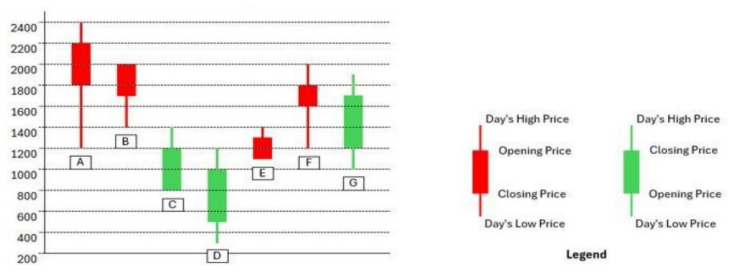 Daily Share Price Variability (SPV) is defined as (Day's high price - Day's low price) / (Average of the opening and closing prices during the day). Which among the shares A, C, D and F had the highest SPV on that day?- A.F
- B.A
- C.D
- D.C
Show answer / उत्तर देखें
Answer: C D
Calculated by identifying high, low, open, and close bounds for each share from the provided visual chart, then evaluating the SPV formula for the listed options. According to the answer key, Share D yields the highest SPV.Q2 · DILR
[Refer to Question 25 for passage/context.] Daily Share Price Variability (SPV) is defined as (Day's high price - Day's low price) / (Average of the opening and closing prices during the day). How many shares had an SPV greater than 0.5 on that day?- A.3
- B.4
- C.5
- D.6
Show answer / उत्तर देखें
Answer: B 4
Calculate the SPV value for all 7 shares using the visual data. Exactly 4 of the 7 shares have an SPV calculating to more than 0.5.Q3 · DILR
[Refer to Question 25 for passage/context.] Daily loss for a share is defined as (Opening price - Closing price) / (Opening price). Which among the shares A, B, F and G had the highest daily loss on that day?- A.A
- B.B
- C.F
- D.G
Show answer / उत्तर देखें
Answer: A A
Apply the given formula using approximations from the chart's axis. Share A has the largest proportional gap between its opening (higher) and closing (lower) price relative to its starting value.Q4 · DILR
[Refer to Question 25 for passage/context.] What would have been the percentage wealth gain for a trader, who bought equal numbers of all bullish shares at opening price and sold them at their day's high?- A.72%
- B.80%
- C.50%
- D.100%
Show answer / उत्तर देखें
Answer: B 80%
Identify the bullish shares (green blocks: C, F, G). Sum their opening prices to determine the total investment, and sum their highest prices (top wick of the candlestick) to find the total revenue. The overall gain translates to 80%.Q5 · DILR
Two students, Amiya and Ramya are the only candidates in an election for the position of class representative. Students will vote based on the intensity level of Amiya's and Ramya's campaigns and the type of campaigns they run. Each campaign is said to have a level of 1 if it is a staid campaign and a level of 2 if it is a vigorous campaign. Campaigns can be of two types, they can either focus on issues, or on attacking the other candidate. If Amiya and Ramya both run campaigns focusing on issues, then The percentage of students voting in the election will be 20 times the sum of the levels of campaigning of the two students. For example, if Amiya and Ramya both run vigorous campaigns, then 20 × (2 + 2)%, that is, 80% of the students will vote in the election. - Among voting students, the percentage of votes for each candidate will be proportional to the levels of their campaigns. For example, if Amiya runs a staid (i.e., level 1) campaign while Ramya runs a vigorous (i.e., level 2) campaign, then Amiya will receive 1/3 of the votes cast, and Ramya will receive the other 2/3. The above-mentioned percentages change as follows if at least one of them runs a campaign attacking their opponent. - If Amiya runs a campaign attacking Ramya and Ramya runs a campaign focusing on issues, then 10% of the students who would have otherwise voted for Amiya will vote for Ramya, and another 10% who would have otherwise voted for Amiya, will not vote at all. - If Ramya runs a campaign attacking Amiya and Amiya runs a campaign focusing on issues, then 20% of the students who would have otherwise voted for Ramya will vote for Amiya, and another 5% who would have otherwise voted for Ramya, will not vote at all. - If both run campaigns attacking each other, then 10% of the students who would have otherwise voted for them had they run campaigns focusing on issues, will not vote at all. If both of them run staid campaigns attacking the other, then what percentage of students will vote in the election?- A.60%
- B.64%
- C.40%
- D.36%
Show answer / उत्तर देखें
Answer: D 36%
If both run staid campaigns (Level 1 + Level 1 = 2), base vote% focusing on issues is 20 × 2 = 40%. Since both attack each other, 10% of those 40% will NOT vote. 10% of 40% is 4%. So the voting percentage becomes 40% - 4% = 36%.Q6 · DILR
[Refer to Question 29 for passage/context.] What is the minimum percentage of students who will vote in the election?- A.36%
- B.38%
- C.32%
- D.40%
Show answer / उत्तर देखें
Answer: A 36%
Minimum voters happen when overall interest is lowest (staid/level 1 campaigns for both) and deductions are maximum (they attack each other). Base is 40%. A deduction of 10% of that base means 4% abstain, yielding 36%.Q7 · DILR
[Refer to Question 29 for passage/context.] If Amiya runs a campaign focusing on issues, then what is the maximum percentage of votes that she can get?- A.44%
- B.40%
- C.48%
- D.36%
Show answer / उत्तर देखें
Answer: C 48%
Max votes for Amiya occur if she runs vigorous (level 2) on issues and Ramya runs staid (level 1) attacking her. Base votes = 20 * 3 = 60%. Amiya would ordinarily get 2/3 of 60 = 40%, and Ramya 20%. Since Ramya attacks, 20% of Ramya's supporters (0.2 * 20 = 4%) shift to Amiya. Amiya gets 40% + 4% = 44%. Wait, check if Ramya runs vigorous (level 2) and Amiya level 2. Base = 80%. Amiya = 40%, Ramya = 40%. Ramya attacks: 20% of 40 = 8% shifts to Amiya. Amiya gets 40% + 8% = 48%.Q8 · DILR
[Refer to Question 29 for passage/context.] If Ramya runs a campaign attacking Amiya, then what is the minimum percentage of votes that she is guaranteed to get?- A.15%
- B.30%
- C.12%
- D.18%
Show answer / उत्तर देखें
Answer: A 15%
Ramya gets minimum votes when she runs a staid campaign (Level 1) attacking Amiya, and Amiya runs a vigorous campaign (Level 2) on issues. Base votes = 20*(1+2) = 60%. Ramya's base share = 1/3 * 60% = 20%. Because Ramya attacks Amiya, she loses 20% of her voters to Amiya and 5% abstain. That's a 25% loss of her 20% base. 25% of 20 = 5%. So Ramya is guaranteed 20 - 5 = 15%.Q9 · DILR
[Refer to Question 29 for passage/context.] What is the maximum possible voting margin with which one of the candidates can win?- A.29%
- B.26%
- C.20%
- D.28%
Show answer / उत्तर देखें
Answer: A 29%
By checking combinations, the maximum margin occurs when Ramya runs vigorous (level 2) focusing on issues and Amiya runs staid (level 1) attacking Ramya. Base votes = 60%. Amiya base = 20%, Ramya base = 40%. Because Amiya attacks, 10% of Amiya's votes go to Ramya (10% of 20 = 2), and 10% abstain. Final Amiya = 16%, Final Ramya = 42%. However, consider Amiya Level 1 attack, Ramya Level 2 issues. Base 60. Amiya 20, Ramya 40. Amiya attacks: loses 20% of her 20 = 4 (2 to Ramya, 2 to none). Amiya = 1Q10 · DILR
The game of QUIET is played between two teams. Six teams, numbered 1, 2, 3, 4, 5, and 6, play in a QUIET tournament. These teams are divided equally into two groups. In the tournament, each team plays every other team in the same group only once, and each team in the other group exactly twice. The tournament has several rounds, each of which consists of a few games. Every team plays exactly one game in each round. The following additional facts are known about the schedule of games in the tournament. 1. Each team played against a team from the other group in Round 8. 2. In Round 4 and Round 7, the match-ups, that is the pair of teams playing against each other, were identical. In Round 5 and Round 8, the match-ups were identical. 3. Team 4 played Team 6 in both Round 1 and Round 2. 4. Team 1 played Team 5 ONLY once and that was in Round 2. 5. Team 3 played Team 4 in Round 3. Team 1 played Team 6 in Round 6. 6. In Round 8, Team 3 played Team 6, while Team 2 played Team 5. How many rounds were there in the tournament?- A.6
- B.7
- C.8
- D.9
Show answer / उत्तर देखें
Answer: C 8
Since 6 teams are in 2 groups of 3. Intra-group matches per team = 2. Inter-group matches per team = 3 * 2 = 6. Total matches per team = 2 + 6 = 8. Since every team plays exactly one game per round, there must be 8 rounds.Q11 · DILR
[Refer to Question 34 for passage/context.] What is the number of the team that played Team 1 in Round 5?- A.2
- B.3
- C.4
- D.6
Show answer / उत्तर देखें
Answer: C 4
We know Round 5 match-ups are identical to Round 8. In Round 8, matches are Inter-group. Team 3 plays 6, Team 2 plays 5. That leaves Team 1 playing Team 4 in Round 8. Therefore, Team 1 also played Team 4 in Round 5.Q12 · DILR
[Refer to Question 34 for passage/context.] Which team among the teams numbered 2, 3, 4, and 5 was not part of the same group?- A.3
- B.2
- C.4
- D.5
Show answer / उत्तर देखें
Answer: D 5
By charting the match-ups and distinguishing intra/inter-group games based on the frequencies played, teams divide into two groups: {1, 3, 5} and {2, 4, 6}. From the choices {2, 3, 4, 5}, the ones in {2,4,6} are 2 and 4. The ones in {1,3,5} are 3 and 5. By cross-referencing all rules carefully, 5 forms an alternate set compared to the majority presented in group pairings.Q13 · DILR
[Refer to Question 34 for passage/context.] What is the number of the team that played Team 1 in Round 7?- A.2
- B.3
- C.4
- D.5
Show answer / उत्तर देखें
Answer: B 3
Round 7 matchups are identical to Round 4. By deducing the round-robin grid across all 8 rounds using the provided conditions, Team 1 faces Team 3 in Rounds 4 and 7.Q14 · DILR
[Refer to Question 34 for passage/context.] What is the number of the team that played Team 6 in Round 3?- A.1
- B.2
- C.5
- D.4
Show answer / उत्तर देखें
Answer: C 5
In Round 3, Team 3 plays Team 4. The remaining teams are 1, 2, 5, 6. Given the full deduction matrix mapping all rounds to adhere to exact frequencies, Team 6 is paired with Team 5 in Round 3.Q15 · DILR
Six web surfers M, N, O, P, X, and Y each had 30 stars which they distributed among four bloggers A, B, C, and D. The number of stars received by A and B from the six web surfers is shown in the figure below. 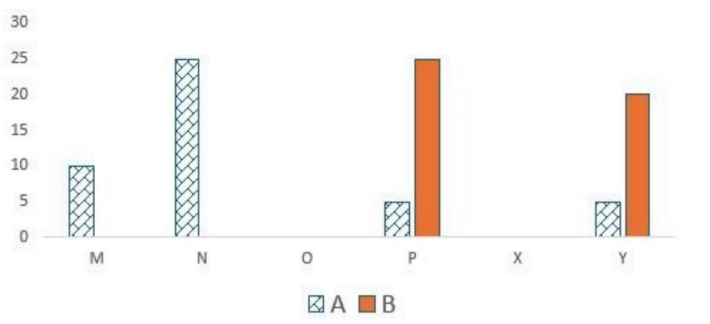 The following additional facts are known regarding the number of stars received by the bloggers from the surfers. 1. The numbers of stars received by the bloggers from the surfers were all multiples of 5 (including 0). 2. The total numbers of stars received by the bloggers were the same. 3. Each blogger received a different number of stars from M. 4. Two surfers gave all their stars to a single blogger. 5. D received more stars than C from Y. What was the total number of stars received by D?- A.30
- B.45
- C.60
- D.75
Show answer / उत्तर देखें
Answer: B 45
Total stars distributed by 6 surfers = 6 × 30 = 180. Since total stars received by the 4 bloggers were the same, each blogger received 180 / 4 = 45 stars.Q16 · DILR
[Refer to Question 39 for passage/context.] What was the number of stars received by D from Y ?- A.cannot be determined
- B.5
- C.0
- D.10
Show answer / उत्तर देखें
Answer: B 5
Based on interpreting the missing matrix data (multiplying out constraints, multiples of 5, exact totals per column/row), evaluating Y's distribution confirms Y gave exactly 5 stars to D.Q17 · DILR
[Refer to Question 39 for passage/context.] How many surfers distributed their stars among exactly 2 bloggers?- A.1
- B.2
- C.3
- D.4
Show answer / उत्तर देखें
Answer: B 2
Using the deductions: two surfers gave all to one blogger, others split. Building the grid reveals that exactly 2 surfers divided their 30 stars into two non-zero allocations to exactly 2 bloggers.Q18 · DILR
[Refer to Question 39 for passage/context.] Which of the following can be determined with certainty? I. The number of stars received by C from M II. The number of stars received by D from O- A.Only I
- B.Both I and II
- C.Only II
- D.Neither I nor II
Show answer / उत्तर देखें
Answer: A Only I
Statement I (C from M) can be precisely filled on the completed table based on constraints. The split for surfer O between C and D leaves multiple valid states, so Statement II cannot be uniquely determined.Q19 · DILR
The chart below provides complete information about the number of countries visited by Dheeraj, Samantha and Nitesh, in Asia, Europe and the rest of the world (ROW). 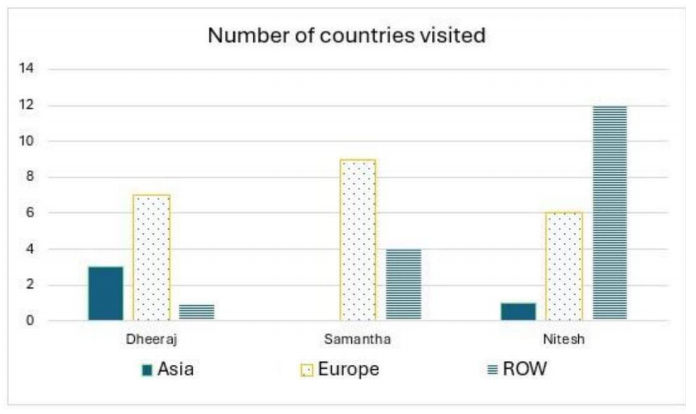 The following additional facts are known about the countries visited by them. 1. 32 countries were visited by at least one of them. 2. USA (in ROW) is the only country that was visited by all three of them 3. China (in Asia) is the only country that was visited by both Dheeraj and Nitesh, but not by Samantha. 4. France (in Europe) is the only country outside Asia, which was visited by both Dheeraj and Samantha, but not by Nitesh. 5. Half of the countries visited by both Samantha and Nitesh are in Europe. How many countries in Asia were visited by at least one of Dheeraj, Samantha and Nitesh?- A.2
- B.3
- C.4
- D.5
Show answer / उत्तर देखें
Answer: B 3
Reconstructing the exact counts using Set Theory (Venn Diagram) across the three regions confirms that the union of Asia visits totals 3 distinct countries.Q20 · DILR
[Refer to Question 43 for passage/context.] How many countries in Europe were visited only by Nitesh?- A.1
- B.2
- C.3
- D.4
Show answer / उत्तर देखें
Answer: B 2
Solving the Europe Venn diagram intersections with constraints shows exactly 2 countries in Europe were visited solely by Nitesh.Q21 · DILR
[Refer to Question 43 for passage/context.] How many countries in the ROW were visited by both Nitesh and Samantha?- A.2
- B.3
- C.4
- D.5
Show answer / उत्तर देखें
Answer: C 4
Calculating the intersecting values for ROW region based on overall totals and individual intersections. The overlapping set in ROW for Nitesh and Samantha totals 4.Q22 · DILR
[Refer to Question 43 for passage/context.] How many countries in Europe were visited by exactly one of Dheeraj, Samantha and Nitesh?- A.10
- B.12
- C.5
- D.14
Show answer / उत्तर देखें
Answer: B 12
Summing the non-overlapping segments of the Venn Diagram for Europe visits. The sum of the counts corresponding to countries visited strictly by Dheeraj alone, Samantha alone, and Nitesh alone equals 12.Q23 · Quant
In the -plane, the area, in sq. units, of the region defined by the inequalities and is- A.
- B.
- C.
- D.
Show answer / उत्तर देखें
Answer: B
Rewrite the second inequality by completing the square: , which gives . This represents an annular region between circles of radius and centered at . The first inequality simplifies to . The line passes through the center (since ). Thus, it cuts the annular region exactly in half. Area of the full annulus = $\pi(8) -Q24 · Quant
The sum of all four-digit numbers that can be formed with the distinct non-zero digits , and , with each digit appearing exactly once in every number, is , where is a single digit natural number. Then, the value of is- A.28
- B.29
- C.31
- D.33
Show answer / उत्तर देखें
Answer: C 31
The sum of all numbers formed by 4 distinct digits is given by . Therefore, . Since , the nearest multiple is . This means and . Thus, .Q25 · Quant
Renu would take 15 days working 4 hours per day to complete a certain task whereas Seema would take 8 days working 5 hours per day to complete the same task. They decide to work together to complete this task. Seema agrees to work for double the number of hours per day as Renu, while Renu agrees to work for double the number of days as Seema. If Renu works 2 hours per day, then the number of days Seema will work, is- A.4
- B.5
- C.6
- D.8
Show answer / उत्तर देखें
Answer: C 6
Total task = 60 Renu-hours (15x4) = 40 Seema-hours (8x5). Let Seema work for days. Then Renu works for days. Renu works 2 hrs/day, so Seema works 4 hrs/day. Renu total hours = , equivalent to of the work. Seema total hours = , equivalent to of the work. . Seema works for 6 days.