JEE Main 2026 — Previous Year Questions
Real questions from the 2026 paper with options and answers. Take a timed test →
75 questions · page 1 of 3
Q1 · Chemistry
Given below are two statements : Statement (I) : The first ionisation enthalpy of the elements Na, Mg, Cl and Ar follows the order Na > Mg > Cl > Ar. Statement (II) : Among Ca, Al, Fe and B, the third ionisation enthalpy is very high for Ca. In the light of the above statements, choose the correct answer from the options given below :- A.Both Statement I and Statement II are true
- B.Both Statement I and Statement II are false
- C.Statement I is true but Statement II is false
- D.Statement I is false but Statement II is true
Show answer / उत्तर देखें
Answer: D Statement I is false but Statement II is true
Statement (I): Ionization enthalpy generally increases across a period from left to right. The correct order of first ionization enthalpy for these period 3 elements is Ar > Cl > Mg > Na. Therefore, the statement stating Na > Mg > Cl > Ar is false. Statement (II): Calcium (Ca) has the electronic configuration . After the removal of 2 valence electrons, the third electron must be removed from the highly stable, completely filled noble gas core . This requires a significantly highQ2 · Chemistry
Given below are two statements : Statement (I) : Oxidising power of halogens decreases in the order , which is the basis of "Layer test". Statement (II) : "Layer test" to identify and in aqueous solution involves the oxidation of bromide or iodide into or respectively with , which is a type of displacement redox reaction. In the light of the above statements, choose the correct answer from the options given below :- A.Both Statement I and Statement II are true
- B.Both Statement I and Statement II are false
- C.Statement I is true but Statement II is false
- D.Statement I is false but Statement II is true
Show answer / उत्तर देखें
Answer: A Both Statement I and Statement II are true
Statement I is correct: The standard reduction potentials (oxidising power) of halogens follow the order . The stronger oxidizing halogen can displace the halide ion of a weaker halogen from its salt. Statement II is correct: The "Layer test" (or carbon disulfide/chloroform test) relies on the fact that chlorine gas or chlorine water is a stronger oxidizing agent than and . Thus, oxidizes to (orange-red layer) and to (violet lQ3 · Chemistry
Given below are two statements : Statement (I) : 1,2,3-Trihydroxypropane can be separated from water by simple distillation. Statement (II) : An azeotropic mixture cannot be separated by fractional distillation. In the light of the above statements, choose the correct answer from the options given below :- A.Both Statement I and Statement II are true
- B.Both Statement I and Statement II are false
- C.Statement I is true but Statement II is false
- D.Statement I is false but Statement II is true
Show answer / उत्तर देखें
Answer: D Statement I is false but Statement II is true
Statement I: 1,2,3-trihydroxypropane (glycerol) has a very high boiling point and decomposes at or near its boiling point under normal atmospheric pressure. Thus, it cannot be purified by simple distillation; instead, it is separated by distillation under reduced pressure. (Statement I is false) Statement II: Azeotropic mixtures boil at a constant temperature without any change in composition. The vapor has the exact same composition as the liquid. Therefore, they cannot be separated into theirQ4 · Chemistry
Given below are two statements : Statement (I) : Benzyl chloride reacts faster in mechanism than ethyl chloride. Statement (II) : Ethyl carbocation intermediate is less stabilized by hyperconjugation than benzyl carbocation by resonance. In the light of the above statements, choose the correct answer from the options given below :- A.Both Statement I and Statement II are true
- B.Both Statement I and Statement II are false
- C.Statement I is true but Statement II is false
- D.Statement I is false but Statement II is true
Show answer / उत्तर देखें
Answer: A Both Statement I and Statement II are true
Statement I: The reaction rate is determined by the stability of the intermediate carbocation. Benzyl chloride forms a benzyl carbocation, which is resonance stabilized, making it highly stable. Ethyl chloride forms an ethyl carbocation (), which is significantly less stable. Therefore, benzyl chloride reacts much faster. (True) Statement II: The benzyl carbocation () is greatly stabilized by delocalization of the positive charge around the aromatic ring (resonance)Q5 · Chemistry
In IUPAC nomenclature, the correct order of decreasing priority of functional group is :- A.
- B.
- C.
- D.
Show answer / उत्तर देखें
Answer: C
The standard IUPAC priority order of common functional groups for nomenclature decreases in the following order: Carboxylic acids () > Sulphonic acids () > Esters () > Acid halides () > Amides () > Nitriles () > Aldehydes () > Ketones () > Alcohols () > Amines () > Alkenes () > Alkynes (). Looking at the options: (a) places Ketone () over Aldehyde (), which is incorrect. (b) places Amide (Q6 · Chemistry
For the molecule N-phenylpiperidine (in which the phenyl ring is substituted by a cyclic nitrogen containing group), the preferred site for the attack of an electrophile on the phenyl ring is : (Let 'p' and 's' denote the ortho positions, 'r' the meta position, and 'u' the para position relative to the nitrogen atom substituent on the phenyl ring)- A.Predominantly at "r"
- B."r" and "u"
- C."p" and "s"
- D.Predominantly at "u"
Show answer / उत्तर देखें
Answer: D Predominantly at "u"
In N-phenylpiperidine, the phenyl ring is bonded to a nitrogen atom that has a lone pair of electrons. The nitrogen lone pair undergoes delocalization with the system of the benzene ring through +M (mesomeric) effect. This makes the nitrogen substituent a strongly activating, ortho/para directing group. Consequently, electrophilic aromatic substitution occurs rapidly at the ortho and para positions. However, due to the significant steric hindrance posed by the bulky piperidine ring attachQ7 · Chemistry
Match List - I with List - II. List - I: Mixture of Compounds A. Diethyl amine + Ethyl amine B. Acetaldehyde + Acetone C. Ethanol + Phenol D. Benzoic acid + Cinnamic acid List - II: Reagent used to distinguish I. Bromine water II. III. Neutral IV. Ammonical silver nitrate Choose the correct answer from the options given below :- A.A-IV, B-II, C-I, D-III
- B.A-IV, B-II, C-III, D-I
- C.A-II, B-IV, C-I, D-III
- D.A-II, B-IV, C-III, D-I
Show answer / उत्तर देखें
Answer: D A-II, B-IV, C-III, D-I
A. Diethyl amine () + Ethyl amine () : Primary amines undergo the carbylamine reaction. Reagents: (II). B. Acetaldehyde + Acetone : Acetaldehyde is an aldehyde and can be oxidized by Tollens' reagent (Ammonical silver nitrate), giving a silver mirror, whereas acetone (a ketone) does not respond. (IV) C. Ethanol + Phenol : Phenol forms a colored complex (typically violet) with neutral , while ethanol does not. (III) D. Benzoic acid + Cinnamic acidQ8 · Chemistry
Consider the three aromatic molecules (P, Q and R): P is N,N-dimethylaniline; Q is N,N-dimethyl-o-toluidine (one methyl group at ortho position); and R is N,N-dimethyl-2,6-xylidine (two methyl groups at ortho positions). The correct order regarding the reactivity of these compounds with (benzene diazonium chloride) under optimum but slightly acidic medium is :- A.P > Q > R
- B.R > P > Q
- C.R > Q > P
- D.P > R > Q
Show answer / उत्तर देखें
Answer: A P > Q > R
The coupling reaction of the given amines with benzene diazonium chloride involves electrophilic aromatic substitution on the ring attached to the nitrogen atom. The reactivity depends entirely on the +M activating effect of the group. For the effect to operate maximally, the unhybridized p-orbital on nitrogen (containing the lone pair) must be parallel to the p-orbitals of the benzene ring. In Q (one ortho methyl) and even more so in R (two ortho methyls), steric repulsion betweenQ9 · Chemistry
Match List - I with List - II. List - I: Vitamin A. Vitamin B. Vitamin C. Vitamin D. Vitamin C List - II: Name I. Pyridoxine II. Ascorbic acid III. Thiamine IV. Riboflavin Choose the correct answer from the options given below :- A.A-II, B-I, C-III, D-IV
- B.A-IV, B-III, C-II, D-I
- C.A-III, B-IV, C-I, D-II
- D.A-I, B-III, C-II, D-IV
Show answer / उत्तर देखें
Answer: C A-III, B-IV, C-I, D-II
Matching the vitamins with their chemical names: A. Vitamin corresponds to Thiamine (III). B. Vitamin corresponds to Riboflavin (IV). C. Vitamin corresponds to Pyridoxine (I). D. Vitamin C corresponds to Ascorbic acid (II). The correct pairing is A-III, B-IV, C-I, D-II.Q10 · Chemistry
One mole of an alkane (x) requires 8 mole oxygen for complete combustion. Sum of number of carbon and hydrogen atoms in the alkane (x) is _______.- A.15
- B.16
- C.17
- D.18
Show answer / उत्तर देखें
Answer: C 17
The general formula for the complete combustion of an alkane () is: We are given that 1 mole of the alkane requires 8 moles of . Therefore: . The alkane is pentane, with formula . The number of carbon atoms is 5 and the number of hydrogen atoms is 12. The sum of carbon and hydrogen atoms is .Q11 · Chemistry
Given below are two statements: Statement I: The second ionization enthalpy of B, Al and Ga is in the order of . Statement II: The correct order in terms of first ionization enthalpy is . In the light of the above statements, choose the correct answer from the options given below:- A.Both Statement I and Statement II are true
- B.Both Statement I and Statement II are false
- C.Statement I is true but Statement II is false
- D.Statement I is false but Statement II is true
Show answer / उत्तर देखें
Answer: B Both Statement I and Statement II are false
Statement I is False: The 2nd ionization enthalpy requires removing an electron from the completely filled s-orbital. The order of for Group 13 elements is . Gallium has a higher than Aluminum due to poor shielding by the 10 d-electrons in Ga's inner shell. Statement II is False: The first ionization enthalpy of Group 14 elements broadly decreases down the group but increases slightly from Sn to Pb due to the lanthanide contraction (poor shielding of 4f electrons). TheQ12 · Chemistry
Which of the following complexes will show coordination isomerism? A. B. C. D. E. Choose the correct answer from the options given below:- A.B, C and D Only
- B.B, D and E Only
- C.A, C and D Only
- D.C, D and E Only
Show answer / उत्तर देखें
Answer: B B, D and E Only
Coordination isomerism arises when both the cation and anion are complex ions, and isomerism occurs due to the interchange of ligands between the two coordination spheres. Such interchange yields a distinctly new compound (salt) mostly when the central metal atoms in the complex cation and anion are different. For B, D, and E, the central metal atoms in the cationic and anionic parts are different (Co/Cr, Fe/Co, Co/Fe). For instance, in B, exchanging ligands produces , whQ13 · Chemistry
Given below are two statements: Statement I: In , the carbocation is stabilised by effect of group. Statement II: In , the carbanion is stabilised by effect of group. In the light of the above statements, choose the correct answer from the options given below:- A.Both Statement I and Statement II are true
- B.Both Statement I and Statement II are false
- C.Statement I is true but Statement II is false
- D.Statement I is false but Statement II is true
Show answer / उत्तर देखें
Answer: A Both Statement I and Statement II are true
Statement I is true: The group attached to a phenyl ring exerts an electron-donating resonance effect ( effect) via lone pairs on the oxygen atom, which significantly stabilizes a positive charge (carbocation). Statement II is true: The group exerts a strong electron-withdrawing resonance effect ( effect), which heavily stabilizes a negative charge (carbanion) effectively dispersing the extra electron density.Q14 · Chemistry
The compound (X) on (i) heating in the presence of anhydrous and HCl gas gives 2,4-dimethyl pentane (ii) aromatization gives toluene and (iii) cyclisation gives methyl cyclohexane The correct name of compound (X) is:- A.Hept-2-ene
- B.Hept-1,3,5-triene
- C.Heptane
- D.Hept-2,4,6-triene
Show answer / उत्तर देखें
Answer: C Heptane
Compound (X) must be an alkane since it undergoes isomerisation with anhydrous /HCl to give branched alkanes like 2,4-dimethylpentane. Aromatisation of -heptane over oxides of transition metals at high temperature yields toluene, and its cyclisation gives methylcyclohexane. Hence, compound (X) is -heptane.Q15 · Chemistry
Correct statements regarding alkyl halides among the following are: A. Alcohol being less polar solvent as compared to water, alcoholic KOH favours elimination reaction with . B. Order of reactivity towards mechanism is . C. Non substituted aryl halides exhibit properties similar to alkyl halides. D. Vinyl chloride is an example of haloalkene and allyl chloride is an example of haloalkyne. E. can be prepared by reacting with but cannot be prepared by reacting with . Choose the correct answer from the options given below:- A.A, B and C Only
- B.B and D Only
- C.A and E Only
- D.D and E Only
Show answer / उत्तर देखें
Answer: C A and E Only
Statement A is correct: Alcoholic KOH provides the stronger base alkoxide ion, which favours elimination over substitution. Statement B is incorrect: The secondary benzylic carbocation formed from is more stable than the primary benzylic carbocation from . Thus, the order should be reversed. Statement C is incorrect: Aryl halides are much less reactive towards nucleophilic substitution than alkyl halides due to resonance stabilization of the C-X bond. StatemeQ16 · Chemistry
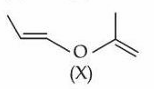 (A substituted cyclic acetal that upon mild acidic hydrolysis yields propanal and acetone) A molecule (X) with following structure under mild acidic condition is hydrolysed to produce (Y) and (Z). Identify the correct statements about (Y) and (Z). A. Both (Y) and (Z) have same molar mass. B. (Y) and (Z) can be distinguished from each other by . C. (Y) and (Z) react with HCN with same rates. D. (Y) and (Z) undergo addition reaction with 2,4-DNP. Choose the correct answer from the options given below:- A.A, B and C Only
- B.B and C Only
- C.C and D Only
- D.A and D Only
Show answer / उत्तर देखें
Answer: D A and D Only
Based on the products, (Y) is propanal () and (Z) is acetone (). A. True. Propanal and acetone are isomers with the formula and both have a molar mass of . B. False. Neither propanal nor acetone reacts with (this test is for carboxylic acids). C. False. Aldehydes (propanal) are sterically less hindered and more electrophilic than ketones (acetone), so propanal reacts with HCN faster than acetone. D. True. Both are carbonyl compounds aQ17 · Chemistry
Identify the correct pair having amino acid (A) and the hormone (B) that is iodinated derivative of the amino acid (A). (T and Y represent one letter code for amino acids)- A.A: T, B: Insulin
- B.A: T, B: Thyroxine
- C.A: Y, B: Thyroxine
- D.A: Y, B: Insulin
Show answer / उत्तर देखें
Answer: C A: Y, B: Thyroxine
The one-letter code for the amino acid Tyrosine is Y, and Threonine is T. Thyroxine is a thyroid hormone that is an iodinated derivative of the amino acid Tyrosine. Insulin is a peptide hormone not derived from a single iodinated amino acid. Thus, the correct pair is Y and Thyroxine.Q18 · Chemistry
What is the ratio of wave number of first line (lowest energy line) of Balmer series of H atomic spectrum to first line of its Brackett series?- A.
- B.
- C.
- D.
Show answer / उत्तर देखें
Answer: B
Wave number is given by the Rydberg formula: . For the first line of the Balmer series, and : . For the first line of the Brackett series, and : $\bar{\nu}_{Brackett} = R_H \left( \frac{1}{4^2} - \frac{1}{5^2} \right) = R_H \left( \Q19 · Chemistry
Given below are two statements: Statement I: For an ideal gas, heat capacity at constant volume is always greater than the heat capacity at constant pressure. Statement II: In a constant volume process, no work is produced and all the heat withdrawn goes into the chaotic motion and is reflected by a temperature increase of the ideal gas. In the light of the above statements, choose the correct answer from the options given below- A.Both Statement I and Statement II are true
- B.Both Statement I and Statement II are false
- C.Statement I is true but Statement II is false
- D.Statement I is false but Statement II is true
Show answer / उत्तर देखें
Answer: D Statement I is false but Statement II is true
Statement I is false because for an ideal gas, the heat capacity at constant pressure () is always greater than the heat capacity at constant volume (). The relation is (). Statement II is true. In an isochoric (constant volume) process, change in volume , thus work done . By the first law of thermodynamics, . All heat exchanged goes entirely to changing the internal energy (associated wiQ20 · Chemistry
In order to oxidise a mixture of mole each of , , and in acidic medium, the number of moles of required is- A.
- B.
- C.
- D.
Show answer / उत्तर देखें
Answer: B
acts as an oxidizing agent in an acidic medium, with its -factor being (). We calculate the equivalents of reducing agents: 1. : Fe goes from to (), goes to (). Total -factor = . (Moles = 1, Eq = 3). 2. : Fe is already in state (), oxalate ions go to (). Total -factor = . (Moles = 1, Eq = 6). 3. $FeSO_4 \to FeQ21 · Chemistry
A monoatomic anion () has neutrons and electrons. Atomic mass, group in the periodic table and physical state at room temperature of the element () respectively are- A., liquid
- B., solid
- C., gas
- D., gas
Show answer / उत्तर देखें
Answer: A , liquid
The monoatomic anion has electrons. This means the neutral atom has electrons. The atomic number , which corresponds to the element Bromine (Br). The atomic mass number = protons + neutrons = . Bromine is in Group (halogens) of the periodic table. The physical state of Bromine at room temperature is a red-brown liquid. So, the properties are , liquid.Q22 · Chemistry
Given below are two statements: Statement I: The covalency of oxygen is generally two but it can exceed upto four. The oxidation state of oxygen in is and in it is . Statement II: The anomalous behaviour of oxygen when compared to the other elements of group is due to its small size and high electronegativity. In the light of the above statements, choose the correct answer from the options given below- A.Both Statement I and Statement II are true
- B.Both Statement I and Statement II are false
- C.Statement I is true but Statement II is false
- D.Statement I is false but Statement II is true
Show answer / उत्तर देखें
Answer: A Both Statement I and Statement II are true
Statement I is true: The normal covalency of oxygen is 2, but it can expand to 3 or 4 (e.g., in or some metal oxides/complexes). Its oxidation state is typically as in , but due to fluorine being more electronegative, oxygen exhibits a oxidation state in . Statement II is true: As the first element in Group 16, oxygen's anomalous behaviour (e.g., forming multiple bonds, hydrogen bonding, being a gas at RT) is heavily attributed to its very small atomic size and higQ23 · Chemistry
Increasing order of electron withdrawing power of following functional groups is: a. b. c. d.- A.
- B.
- C.
- D.
Show answer / उत्तर देखें
Answer: C
The electron-withdrawing power ( effect) dictates the inductive pull of electrons. The generalized descending order of effect strength is: Applying this order: has the weakest effect. is stronger than . is stronger than . is the strongest among them. Thus, the increasing order is .Q24 · Chemistry
An alkene on ozonolysis followed by reduction gives following products: ( moles), , . The alkene is expected to be a triene that undergoes cleavage.- A.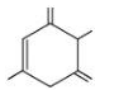
- B.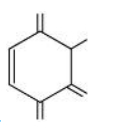
- C.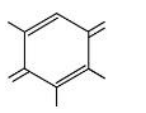
- D.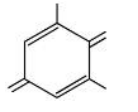
Show answer / उत्तर देखें
Answer: C 
When an alkene undergoes reductive ozonolysis, the double bonds are cleaved and replaced with bonds on the fragments. We are given the pieces: 1. ( moles) - This indicates the original molecule has two terminal groups. 2. (Mesoxaldehyde) - This comes from a fragment that was double bonded at two ends: ? Actually, an internal ketone must mean the central carbon was double-bonded to another fragment. So a cross-conjugated $=CH-Q25 · Chemistry
Match the LIST-I with LIST-II List-I (Name of reaction) A. Finkelstein reaction B. Swarts reaction C. Sandmeyer's reaction D. Fittig reaction List-II (Reagent or catalyst used) I. II. , dry ether III. IV. Choose the correct answer from the options given below:- A.A-I, B-IV, C-III, D-II
- B.A-III, B-I, C-IV, D-II
- C.A-IV, B-II, C-I, D-III
- D.A-I, B-III, C-II, D-IV
Show answer / उत्तर देखें
Answer: B A-III, B-I, C-IV, D-II
A. Finkelstein reaction represents halogen exchange typically using in dry acetone to prepare alkyl iodides. (A -> III) B. Swarts reaction is used to prepare alkyl fluorides by heating an alkyl chloride/bromide in the presence of heavy metal fluorides like , , or . (B -> I) C. Sandmeyer's reaction utilizes cuprous halides like to replace the diazonium group in aromatic rings. (C -> IV) D. Fittig reaction pairs two aryl halides using Sodium () metal in dry