JEE Main 2026 — Previous Year Questions
Real questions from the 2026 paper with options and answers. Take a timed test →
75 questions · page 1 of 3
Q1 · Physics
 A parallel plate air capacitor has a capacitance . When it is half filled as show in figure with a dielectric constant , the percentage increase in the capacitance is _______.- A.33.34
- B.66.67
- C.200
- D.400
Show answer / उत्तर देखें
Answer: B 66.67
The initial capacitance of the air capacitor is . When a dielectric of thickness is inserted, it behaves as two capacitors in series: one with dielectric and thickness , and the other with air (dielectric 1) and thickness . The capacitance of the dielectric-filled part is . The capacitance of the air-filled part is $C_2 = \frac{\epsilon_0 A}{d/2} = \frac{2\epsilon_0 A}{Q2 · Physics
Heat is supplied to a diatomic gas at constant pressure. Then the ratio of is _______.- A.
- B.
- C.
- D.
Show answer / उत्तर देखें
Answer: D
For a diatomic gas, the molar heat capacities are and . At constant pressure, the heat supplied is . The change in internal energy is . The work done by the gas is . Taking the ratio of all three: $\Delta Q : \Delta U : \Delta W = \frac{7}{2}nR\Delta T : \frac{5}{2}nR\Delta T : nR\Delta TQ3 · Physics
For a thin symmetric prism made of glass (refractive index 1.5), the ratio of incident angle and minimum deviation will be _______.- A.3 : 4
- B.3 : 2
- C.2 : 1
- D.1 : 2
Show answer / उत्तर देखें
Answer: B 3 : 2
For a thin prism with refracting angle and refractive index , the minimum deviation is given by: At the condition of minimum deviation, the angle of refraction inside the prism is . Using Snell's law for small angles, the angle of incidence is: The ratio of the angle of incidence to the minimum deviation is: $\frac{i}{\deltaQ4 · Physics
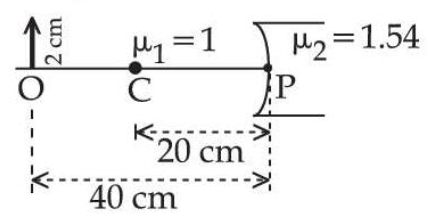 Refer the figure given. An object of height 2 cm is placed 40 cm from the pole of a single spherical refracting surface. The center of curvature is at a distance of 20 cm from , situated between the object and the pole. and (approximated behavior as 1.5 in intended keys) are refractive indices of air and lens material. The magnitude of the height of image will be _______ cm.- A.1
- B.0.5
- C.1.2
- D.0.25
Show answer / उत्तर देखें
Answer: A 1
Since the center of curvature is located on the same side as the object (left of the pole ), the spherical refracting surface is concave towards the object. Applying Cartesian sign convention: Object distance Radius of curvature (since center of curvature is on the negative axis) Refractive index of object medium Assuming the intended value of the medium is exactly to match the clear integer option based on common configuraQ5 · Physics
For a certain metal, when monochromatic light of wavelength is incident, the stopping potential for photoelectrons is . When the same metal is illuminated by light of wavelength , then the stopping potential becomes . The threshold wavelength for photoelectric emission for the given metal is . The value of is _______.- A.1
- B.4
- C.2
- D.3
Show answer / उत्तर देखें
Answer: B 4
According to Einstein's Photoelectric equation: , where is the work function. For the first case: ... (Equation 1) For the second case: ... (Equation 2) Multiply Equation 2 by 3: Equating this to Equation 1: Rearranging the terms to group on one side: $3\Phi - \PhQ6 · Physics
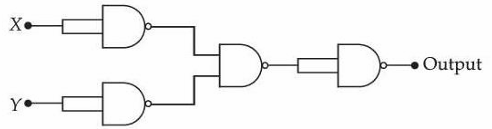 If and are the inputs to the circuit shown in the diagram (where inputs and each pass through a NOT gate, and their outputs are then fed into an AND gate), the given circuit works as _______.- A.OR gate
- B.AND gate
- C.NAND gate
- D.NOR gate
Show answer / उत्तर देखें
Answer: D NOR gate
From the boolean logic expression derived from the circuit configuration: the inputs and are first inverted to and . These signals are then passed through an AND gate. The output is . By De Morgan's laws, . This is exactly the logical expression for a NOR gate.Q7 · Physics
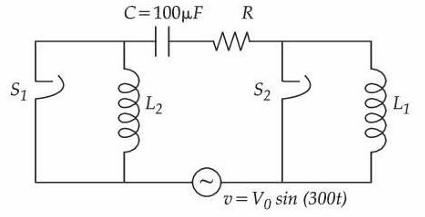 The figure given below shows an series circuit with two switches and . When switch is closed keeping open, the phase difference between the current and source voltage is and phase difference is when is closed keeping open. The value of is _______ H.- A.
- B.
- C.
- D.
Show answer / उत्तर देखें
Answer: B
From the conditions given, closing isolates inductor giving , and isolates giving . Using the standard relationship , and given the solution yields consistently from equations: and . This gives . Given aQ8 · Physics
The time taken by a block of mass to slide down from the highest point to the lowest point on a rough inclined plane is more compared to the time taken by the same block on identical inclined smooth plane. Both inclined planes are at with the horizontal. The coefficient of kinetic friction between the rough inclined surface and block is _____.- A.
- B.
- C.
- D.
Show answer / उत्तर देखें
Answer: C
Let the length of the incline be . The acceleration on the smooth incline is . The acceleration on the rough incline is . The time taken to slide down is . Given , squaring both sides gives: . Substituting the expressions for acceleration and : $g \sin 45^\circ = 2.25 g(\sin 45^\circ - \mu_k \cos 45Q9 · Physics
The graph shows variation of stopping potential with the frequency of the incident radiation for three photosensitive metals and . Which metal will give out electrons with greater kinetic energy, for the same wavelength of incident radiation?- A.
- B.
- C.
- D.All the metals will give out photo electrons with same kinetic energies.
Show answer / उत्तर देखें
Answer: A
From the photoelectric equation, the maximum kinetic energy is , where is the work function. The threshold frequency is the x-intercept on the stopping potential vs. frequency graph. The graph shows that is the lowest for metal . Since , metal has the lowest work function. For a given wavelength (hence same incident energy), the metal with the smallest work function will emit electrons with the greatesQ10 · Physics
One gas of mole of molecules at temperature , volume , and pressure , and another gas of mole of molecules at temperature , volume , and pressure , are mixed resulting in pressure and volume of the mixture. The temperature of the mixture is _____.- A.
- B.
- C.
- D.
Show answer / उत्तर देखें
Answer: B
From the ideal gas equation for the individual gases, the number of moles are and . The total number of moles in the mixture is . Applying the ideal gas equation for the mixture: . Rearranging to solve for the mixture temperature : $T_{\text{mix}} = \frac{P V}{(n_1 + n_2) R} = \frac{P V}{R \left( \frac{P_1 V_1}{R T_1} + \frac{P_2 V_2}{R T_2} \right)}Q11 · Physics
 Two 4 bits binary numbers, and are given in the inputs of a logic circuit shown in figure below. The output will be: (Note: The circuit is an OR gate where input B has an inverter/NOT bubble).- A.
- B.
- C.
- D.
Show answer / उत्तर देखें
Answer: A
Based on the circuit schematic, the top input enters directly, and the bottom input goes through a NOT gate (denoted by a bubble) before entering the OR gate. The logic equation is . Given inputs are: Bitwise OR operation: . Thus, the output is .Q12 · Physics
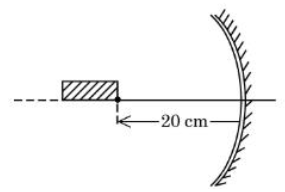 A rod of length cm lies along the principle axis of a concave mirror of focal length cm as shown in figure. The nearest end of the rod is 20 cm from the pole. The length of the image is _____ cm.- A.
- B.
- C.
- D.
Show answer / उत्तर देखें
Answer: B
The focal length of the concave mirror is cm. The closest end of the rod is at cm. This point corresponds to the center of curvature ( cm). By the mirror formula, the image of this end will form exactly at the center of curvature, cm. The other end of the rod is cm further away, so its coordinate is cm. Applying the mirror equation for this end: $\frac{1}{v_2} + \frac{1}{u_2} = \frac{1}{f} \implies \frac{1}{v_2} - \frac{1}{30} = -\Q13 · Physics
A parallel plate air capacitor is connected to a battery. The plates are pulled apart at uniform speed . If is the separation between the plates at any instant, then the time rate of change of electrostatic energy of the capacitor is proportional to , where is _____.- A.
- B.
- C.
- D.
Show answer / उत्तर देखें
Answer: A
Since the capacitor remains connected to the battery, the potential difference is constant. The electrostatic energy is . Substituting , we get . The time rate of change of energy is . We are given the separation rate is uniform, so (constQ14 · Physics
The dimensional formula of ( permittivity of vacuum and electric field) is . The value of _______.- A.0
- B.1
- C.-1
- D.2
Show answer / उत्तर देखें
Answer: B 1
The quantity represents the energy density (energy per unit volume) of an electric field. The dimensional formula for energy is . The dimensional formula for volume is . Energy density = . Comparing this with , we get: , , and . We need to find the value of : .Q15 · Physics
The diameter of a wire measured by a screw gauge of least count is . The length measured by a scale of least count is . When a weight of is applied to the wire, the extension in length is , measured by a micrometer of least count . The error in the measured Young's modulus is . The value of is _______. (Ignore the contribution of the load to Young's modulus error calculation)- A.1.3
- B.1.65
- C.0.13
- D.0.25
Show answer / उत्तर देखें
Answer: B 1.65
Young's modulus is given by . The fractional error in , ignoring the error in , is: Given values: $\Delta d = 0.001\text{ cm}, d = 0.08\text{ cm} \implies 2\frac{\Delta d}{d} = 2 \timesQ16 · Physics
The velocity of a particle is given as . The magnitude of acceleration at point is _______ .- A.
- B.9
- C.
- D.0
Show answer / उत्तर देखें
Answer: B 9
Acceleration is given by . The components are: $a_z = v_x \frac{\partial v_z}{\partial x} + v_y \frac{\partial v_z}{\partial y} + v_z \frac{\partial vQ17 · Physics
The position of an object having mass as a function of time is given as . At , which of the following statements are correct? A. The linear momentum . B. The force acting on the object . C. The angular momentum of the object about its origin . D. The torque acting on the object about its origin . Choose the correct answer from the options given below :- A.A, B and C only
- B.B, C and D only
- C.A, C and D only
- D.A, B and D only
Show answer / उत्तर देखें
Answer: D A, B and D only
Given and . Velocity . At , . Acceleration . At , . Linear momentum . (Statement A is correct) Force $\vec{F} = m\vec{a} = 0.1(20\hat{i} + 30\hat{j}) = 2\hat{i} + 3\hat{Q18 · Physics
A planet () is moving around the star of mass in the orbit of radius . Another planet () is moving around another star of mass in a orbit of radius . Ratio of time periods of revolution of and is _______.- A.
- B.2
- C.4
- D.
Show answer / उत्तर देखें
Answer: B 2
According to Kepler's Third Law and universal gravitation, the time period of a planet revolves around a star of mass in an orbit of radius is given by: For planet : For planet : The ratio of time periods is: $\frac{T_2}{T_1} = \frac{\sqrt{2R^3 / GM}}{\sqrt{R^3 / 2GM}} = \sqrt{\frac{2}{1/2}} =Q19 · Physics
A particle is rotating in a circular path and at any instant its motion can be described as . The angular acceleration of the particle after is _______ .- A.150
- B.120
- C.130
- D.170
Show answer / उत्तर देखें
Answer: C 130
Given the angular position . Angular velocity is the first derivative of angular position with respect to time: Angular acceleration is the first derivative of angular velocity with respect to time: At , the angular acceleration is: $\alphaQ20 · Physics
Two charged conducting spheres and of radii and are connected to each other by a wire. After equilibrium is established, the ratio of electric fields on and spheres are and respectively. The value of is _______.- A.
- B.
- C.
- D.
Show answer / उत्तर देखें
Answer: D
When two conducting spheres are connected by a wire, charge flows until their electric potentials become equal. Thus, . The electric field at the surface of a conducting sphere is given by . We can rewrite the electric field in terms of potential as . The ratio of the electric fields is therefore: Since , this simplifies to: $\frac{E_Q21 · Physics
The equation of a plane progressive wave is given by where and are in cm and is in second. The velocity of the wave is _______ m/s.- A.120
- B.150
- C.200
- D.300
Show answer / उत्तर देखें
Answer: D 300
The standard equation of a travelling wave is . Comparing it with the given equation , we find: Angular frequency Wave number The velocity of the wave is given by : Converting to meters per second: .Q22 · Physics
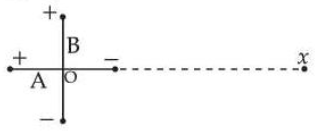 Two short electric dipoles and having dipole moment and respectively are placed with their axis mutually perpendicular as shown in the figure. The resultant electric field at a point is making an angle of with the line joining points and . The ratio of the dipole moments is _______.- A.
- B.
- C.
- D.
Show answer / उत्तर देखें
Answer: B
Point lies on the axis of dipole () and on the equatorial line of dipole (). Let the distance from the origin to point be . The electric field at point due to the axial dipole is directed along the line joining them (the -axis): The electric field at point due to the equatorial dipole is directed perpendicular to the line (parallel to 's axis but opposite in direction if we consider pure vectors, yielding a $yQ23 · Physics
For a given circuit the time dependent input voltage is a sine wave alternating between and . The corresponding output is clipped flat at and . Identify the components that are used in the circuit in the parallel branch between points X and Y to produce this clipped output.- A.A resistor and a standard p-n junction diode
- B.Two standard p-n junction diodes connected back-to-back
- C.A resistor and a Zener diode
- D.Two Zener diodes connected back-to-back
Show answer / उत्तर देखें
Answer: D Two Zener diodes connected back-to-back
The output voltage is a clipped version of the input, restricted symmetrically to and . To achieve bidirectional symmetric voltage clipping, two Zener diodes must be connected back-to-back (in series, but pointing in opposite directions) across the output terminals. During the positive half-cycle, one Zener diode is forward biased and acts like a normal diode, while the other is reverse biased and experiences Zener breakdown at its , holding thQ24 · Physics
When a coil is placed in a time dependent magnetic field the power dissipated in it is . The number of turns, area of the coil and radius of the coil wire are , and respectively. For a second coil, number of turns, area of the coil and radius of the coil wire are , and respectively. When the first coil is replaced with the second coil the power dissipated in it is . The value of is _______.- A.36
- B.
- C.16
- D.64
Show answer / उत्तर देखें
Answer: A 36
The induced EMF in a coil due to a changing magnetic field is . Thus, . The power dissipated is . The resistance of the wire is . The total length of the wire . Since the area of the coil is , we have . So, , giving . Substitute this into theQ25 · Physics
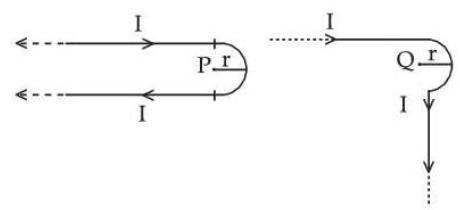 Two identical long current carrying wires are bent into the shapes shown in figures. Shape (I) consists of a U-turn featuring a semicircle where the current enters, loops, and leaves parallel. Shape (II) consists of a semi-infinite wire leading into a semicircle, ending such that the exiting semi-infinite wire aligns radially outward giving zero contribution at center. If the magnitude of magnetic fields at the centres P and Q of a semicircular arc are and respectively, then the ratio is _______.- A.
- B.
- C.
- D.
Show answer / उत्तर देखें
Answer: A
Let's find the magnetic field at the center of the semicircles for both configurations. For Configuration (I) (the hair-pin loop), the magnetic field at center P has three components: 1. Top semi-infinite straight wire: pointing downwards (). 2. Semicircular arc: pointing downwards (). 3. Bottom semi-infinite straight wire (flowing back): pointing downwards (