An electromagnetic wave travelling in x-direction is described by field equation Ey=300sinω(t−cx). If the electron is restricted to move in y-direction only with speed of 1.5×10⁶ m/s then ratio of maximum electric and magnetic forces acting on the electron is _______.
A.200
B.150
C.400
D.300
Show answer / उत्तर देखें
Answer: A200
In an electromagnetic wave in vacuum, the amplitudes of the electric field (E0) and magnetic field (B0) are related by E0=cB0, where c is the speed of light.
The maximum electric force on the electron is FE=eE0.
The maximum magnetic force on the electron moving with speed v is FB=evB0sin(90∘)=evB0 (since the electron moves in the y-direction and magnetic field is in the z-direction, they are mutually perpendicular).
The ratio of the maximum electric fo
Q177 · Physics
Angular momentum of an electron in a hydrogen atom is π3h, then the energy of the electron is _______ eV.
A.-1.51
B.-0.85
C.-0.38
D.-0.28
Show answer / उत्तर देखें
Answer: C-0.38
According to Bohr's quantization condition, the angular momentum L of an electron in the n-th orbit is given by:
L=2πnh
We are given L=π3h. Equating the two expressions:
2πnh=π3h⟹2n=3⟹n=6
The total energy of an electron in the n-th orbit of a hydrogen atom is:
En=−n213.6 eV
Substituting n=6:
E6=−6213.6=−3613.6=−0.3777...≈−0.38 eV.
Q178 · Physics
A liquid drop of diameter 2 mm breaks into 512 droplets. The change in surface energy is α×10−6 J. The value of α is _______. (Take surface tension of liquid =0.08 N/m)
A.10
B.7
C.8
D.11
Show answer / उत्तर देखें
Answer: B7
Let the radius of the large drop be R and the radius of each small droplet be r.
Diameter of large drop =2 mm⟹R=1 mm=10−3 m.
By conservation of volume during splitting into n=512 drops:
34πR3=512×34πr3⟹R3=512r3
Since 512=83, we get r=8R.
The initial surface area is Ai=4πR2.
The final total surface area is $A_f = 512 \times 4\pi r^2 = 512 \times 4\pi \left(\frac{R}{8}\right)
Q179 · Physics
In single slit diffraction pattern, the wavelength of light used is 628 nm and slit width is 0.2 mm, the angular width of central maximum is α×10−2 degrees. The value of α is _______.
A.18
B.36
C.72
D.54
Show answer / उत्तर देखें
Answer: B36
The angular width of the central maximum in a single slit diffraction pattern is given by:
Δθ=a2λ in radians.
Given λ=628 nm=628×10−9 m and a=0.2 mm=0.2×10⁻³ m.
Δθ=0.2×10−32×628×10−9=2×10−41256×10−9=628×10−5=6.28×10⁻³ rad.
Converting radians to degrees:
$\Delta \theta (\text{degrees}) = 6.2
Q180 · Physics
A vessel contains 0.15 m3 of a gas at pressure 8 bar and temperature 140∘C with cp=3R and cv=2R. It is expanded adiabatically till pressure falls to 1 bar. The work done during this process is _______ kJ. (R is gas constant)
A.80
B.100
C.120
D.140
Show answer / उत्तर देखें
Answer: C120
The specific heat ratio is γ=cvcp=2R3R=1.5.
For an adiabatic process, P1V1γ=P2V2γ.
Given P1=8 bar, V1=0.15 m3, and P2=1 bar.
8×(0.15)1.5=1×V21.5⟹(0.15V2)1.5=8
Since 1.5=23, we have 0.15V2=82/3=4.
V2=4×0.15=0.6 m3.
The work done by the gas in an adiabatic process is given by $W = \frac{P_1 V_1
Q181 · Physics
1μC charge moving with velocity v=(i^−2j^+3k^) m/s in the region of magnetic field B=(2i^+3j^−5k^) T. The magnitude of force acting on it is α×10−6 N. The value of α is _______.
A.114
B.152
C.171
D.196
Show answer / उत्तर देखें
Answer: C171
The Lorentz magnetic force on a moving charge is F=q(v×B).
Let's calculate the cross product v×B:
v×B=i^12j^−23k^3−5=i^((−2)(−5)−(3)(3))−j^((1)(−5)−(3)(2))+k^((1)(3)−(−2)(2))=i^(10−9)−j^(−5−6)+k^(3+4)=1i^−(−11)j^+7k^=i^+11j^+7k^
The magnitude is $|\vec{v
Q182 · Physics
A uniform wire of length l of weight w is suspended from the roof with a weight of W at the other end. The stress in the wire at 3l distance from the top is (AW+γ2Aw), where, A is the cross sectional area of the wire. The value of γ is _______.
A.2
B.3
C.4
D.5
Show answer / उत्तर देखें
Answer: B3
Stress in the wire at any point is defined as the total load supported below that point divided by the cross-sectional area A.
A point at a distance l/3 from the top is equivalent to a distance of l−l/3=2l/3 from the bottom.
The total tension at this point must support the hanging weight W plus the weight of the lower portion of the wire.
Since the wire is uniform and has total weight w, the weight of the bottom segment of length 2l/3 is 32w.
Total Tension $T = W + \fr
Q183 · Physics
A tub is filled with water and a wooden cube 10 cm × 10 cm × 10 cm is placed in the water. The wooden cube is found to float on the water with a part of it submerged in water. When a metal coin is placed on the wooden cube, the submerged part is increased by 3.87 cm. The mass of the metal coin is _______ gram. (Take water density as 1 g/cm3 and density of wood as 0.4 g/cm3)
A.258
B.387
C.420
D.516
Show answer / उत्तर देखें
Answer: B387
When the metal coin is added, the total downward weight increases by the weight of the coin. For the block to remain floating, the upward buoyant force must increase by an equivalent amount.
The increase in buoyant force ΔFB is strictly due to the newly displaced volume of water.
ΔFB=McoingΔFB=ρwater×ΔVsubmerged×g
Equating the two: Mcoin=ρwater×ΔVsubmerged.
The extra volume submerged is the area of the
Q184 · Physics
Dimensions of universal gravitational constant (G) in terms of Planck's constant (h), distance (L), mass (M) and time (T) are _______.
A.[hTLM−2]
B.[hT−1LM−2]
C.[hTL2M−2]
D.[h−1T−1LM−2]
Show answer / उत्तर देखें
Answer: B[hT−1LM−2]
The standard dimensional formula for the universal gravitational constant is [G]=[M−1L3T−2].
We are asked to express it in terms of h,L,M,T. Let's test the dimensions of the given options.
The dimensions of Planck's constant h are [h]=[ML2T−1].
Evaluating option (b):
[hT−1LM−2]=[ML2T−1][T−1][L][M−2]=[M1−2L2+1T−1−1]=[M−1L3T−2].
This matches exactly with the dimensions of G.
Q185 · Physics
A 0.5 kg mass is in contact against the inner wall of a cylindrical drum of radius 4 m rotating about its vertical axis. The minimum rotational speed of the drum to enable the mass to remain stuck to the wall (without falling) is 5 rad/s. The coefficient of friction between the drum's inner wall surface and mass is _______ . (Take g=10 m/s2)
A.0.1
B.0.5
C.0.7
D.0.3
Show answer / उत्तर देखें
Answer: A0.1
For the mass to remain stuck without falling, the upward static friction must balance the downward gravitational force: f=mg.
The normal force provided by the wall is the centripetal force: N=mω2r.
The maximum static friction is fmax=μN=μmω2r.
Setting mg=μmω2r, the mass m cancels out.
μ=ω2rg=52×410=25×410=10010=0.1.
Q186 · Physics
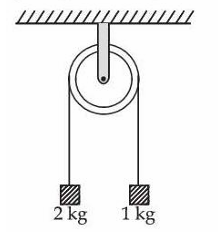 (Two blocks are suspended from a pulley)
Two blocks of masses 2 kg and 1 kg respectively, are tied to the ends of a string which passes over a light frictionless pulley as shown in the figure below. The masses are held at rest at the same horizontal level and then released. The distance traversed by the centre of mass in 2 s is _______ m. (Take g=10 m/s2)
A.3.33
B.3.12
C.2.22
D.1.42
Show answer / उत्तर देखें
Answer: C2.22
Let m1=2 kg and m2=1 kg. The acceleration of the blocks is given by a=m1+m2m1−m2g=2+12−1×10=310 m/s2.
The 2 kg block accelerates downwards (let's call this negative), and the 1 kg block accelerates upwards.
The acceleration of the centre of mass is acom=m1+m2m1(−a)+m2(a)=32(−10/3)+1(10/3)=3−10/3=−910 m/s2.
The magnitude of acce
Q187 · Physics
A particle having charge 10−9 C moving in x-y plane in fields of 0.4j^ N/C and 4×10⁻³k^ T experiences a force of (4i^+2j^)×10−10 N. The velocity of the particle at that instant is _______ m/s.
A.50i^+100j^
B.100i^+50j^
C.−50i^+100j^
D.50i^−100j^
Show answer / उत्तर देखें
Answer: A50i^+100j^
Let velocity v=vxi^+vyj^. Lorentz force F=q(E+v×B).
v×B=(vxi^+vyj^)×(4×10⁻³k^)=4×10⁻³vx(−j^)+4×10⁻³vy(i^).
The net force is F=10−9[(4×10⁻³vy)i^+(0.4−4×10⁻³vx)j^].
Given F=4×10⁻¹⁰i^+2×10⁻¹⁰j^. Comparing components:
x-component:
Q188 · Physics
If a body of mass 1 kg falls on the earth from infinity, it attains velocity (v) and kinetic energy (k) on reaching the surface of earth. The values of v and k respectively are _______. (Take radius of earth to be 6400 km and g=9.8 m/s2)
A.11.2 km/s;6.27×107 J
B.11.2 km/s;12.54×107 J
C.8.8 km/s;6.27×107 J
D.8.8 km/s;12.54×107 J
Show answer / उत्तर देखें
Answer: A11.2 km/s;6.27×107 J
By conservation of energy, the kinetic energy attained by falling from infinity is equal to the magnitude of potential energy at the surface of the Earth: K=RGMm=mgR.
Given m=1 kg,g=9.8 m/s2,R=6400×103 m.
K=1×9.8×6400×103=62.72×10⁶ J=6.272×10⁷ J.
The velocity attained is the escape velocity $v = \sqrt{2gR} = \sqrt{2 \times 9.8 \times 6.4 \times 10^6} = \sqrt{125.44 \times 10^6} = 11
Q189 · Physics
In a screw gauge the zero of main scale reference line coincides with the fifth division of the circular scale when two studs are in contact. There are 100 divisions in circular scale and pitch of screw gauge is 0.1 mm. When diameter of a sphere is measured, the reading of main scale is 5 mm and 50th division of circular scale coincides with the reference line of main scale. The diameter of sphere is _______ mm.
A.5.045
B.5.055
C.5.450
D.5.550
Show answer / उत्तर देखें
Answer: A5.045
Least count (LC) = Pitch / No. of divisions = 0.1 mm/100=0.001 mm.
When studs are in contact, 5th division coincides. So positive zero error = +5×0.001=+0.005 mm.
Measured value = Main Scale Reading + (Circular Scale Reading × LC) = 5 mm+50×0.001 mm=5.050 mm.
True diameter = Measured Value − Zero Error = 5.050−0.005=5.045 mm.
Q190 · Physics
The surface tension of a soap bubble is 0.03 N/m. The work done in increasing the diameter of bubble from 2 cm to 6 cm is απ×10−4 J. The value of α is _______.
A.0.86
B.0.64
C.1.92
D.7.68
Show answer / उत्तर देखें
Answer: C1.92
A soap bubble has two free surfaces. Thus, initial surface area A1=2×4πr12 and final area A2=2×4πr22.
Radii are r1=1 cm=0.01 m and r2=3 cm=0.03 m.
Change in area ΔA=8π(r22−r12)=8π(0.0009−0.0001)=8π(0.0008)=0.0064π m2.
Work done W=TΔA=0.03×0.0064π=0.000192π J=1.92π×10−4 J.
Comparing with απ×10−4, we get $\alph
Q191 · Physics
A mixture of carbon dioxide and oxygen has volume 8310 cm3, temperature 300 K, pressure 100 kPa and mass 13.2 g. The number of moles of carbon dioxide and oxygen gases in the mixture respectively are _______. (Assume both carbon dioxide and oxygen gases behave like ideal gases) [R=8.31 J/mol.K]
A.0.15 and 0.18
B.0.25 and 0.08
C.0.21 and 0.12
D.0.13 and 0.20
Show answer / उत्तर देखें
Answer: C0.21 and 0.12
From ideal gas equation, PV=nRT. Total moles n=RTPV.
P=100×103 Pa, V=8310×10−6 m3=8.31×10⁻³ m3.
n=8.31×300105×8.31×10−3=2493831=31=0.333 moles.
Let moles of CO2 be x and O2 be y. Then x+y=1/3. Total mass is 44x+32y=13.2.
Substituting y=1/3−x:
$44x + 32(1/3 - x) = 13.2 \implies 12x + 10.667 = 13.2 \implies 12x = 2.533 \implies x \a
Q192 · Physics
If an air bubble of diameter 2 mm rises steadily through a liquid of density 2000 kg/m3 at a rate of 0.5 cm/s, then the coefficient of viscosity of liquid is _______ Poise. (Take g=10 m/s2)
A.0.88
B.8.8
C.88.8
D.0.088
Show answer / उत्तर देखें
Answer: B8.8
For an air bubble rising steadily, terminal velocity v=9η2r2(ρliq−ρair)g. Since ρair is negligible, v≈9η2r2ρliqg.
We need η=9v2r2ρliqg.
Given r=1 mm=10−3 m, v=0.5 cm/s=5×10−3 m/s.
$\eta = \frac{2 \times (10^{-3})^2 \times 2000 \times 10}{9 \times 5 \times 10^{-3}} = \frac{40 \times 10^{-6}}{45 \times 10^{-3}} = \frac{40}{45} \times 10^{-3}\text{ Pa.s
Q193 · Physics
A spherical ball of mass 2 kg falls from a height of 10 m and is brought to rest after penetrating 10 cm into sand. The average force exerted by sand on the ball is _______ N. (Take g=10 m/s2)
A.1980
B.2020
C.2000
D.1000
Show answer / उत्तर देखें
Answer: B2020
Applying Work-Energy theorem between the starting point and stopping point:
Total work done = ΔK.E=0.
Work done by gravity + Work done by resistive force = 0.
Wgravity=mg(h+d) where h=10 m and d=0.1 m.
Wresistive=−Fd.
mg(h+d)−Fd=0⟹F=dmg(h+d)=0.12×10×(10+0.1)=0.120×10.1=20×101=2020 N.
Q194 · Physics
An electromagnetic wave travels in free space along the x-direction. At a particular point in space and time, B=2×10⁻⁷j^ T is associated with this wave. The value of corresponding electric field E at this point is _______ V/m.
A.60k^
B.−60k^
C.30k^
D.−600k^
Show answer / उत्तर देखें
Answer: B−60k^
The direction of propagation of an electromagnetic wave is given by E×B.
Given wave propagates in +i^ direction, and B=Bj^. Thus, E^×j^=i^. Since (−k^)×j^=i^, the direction of E is −k^.
The magnitude of electric field is E=cB=3×108×2×10−7=60 V/m.
Therefore, E=−60k^ V/m.
Q195 · Physics
Two resistors of 200Ω and 400Ω are connected in series with a battery of 100 V. A bulb rated at 200 V,100 W is connected across the 400Ω resistance. The potential drop across the bulb is _______ V.
A.25
B.50
C.66.6
D.100
Show answer / उत्तर देखें
Answer: B50
Resistance of the bulb Rb=PratedVrated2=100(200)2=400Ω.
The bulb is connected in parallel with the 400Ω resistor. The equivalent resistance of this parallel combination is Rp=400+400400×400=200Ω.
The total resistance of the circuit is Req=200Ω (series part)+Rp=200+200=400Ω.
The main current I=ReqV=400100=0.25 A.
The potential dr
Q196 · Physics
Two metal plates (A, B) are kept horizontally with separation of (π12) cm, with plate A on the top. An atomizer jet sprays oil (density 1.5 g/cm3) droplets of radius 1 mm horizontally. All oil droplets carry a charge 5 nC. The potentials VA and VB are required on plates A and B respectively in order to ensure the droplets do not descend. The values of VA and VB are _______.
(Neglect the air resistance to the droplets and take g=10 m/s2)
A.100 V and 580 V
B.580 V and 100 V
C.60 V and 400 V
D.0 V and −200 V
Show answer / उत्तर देखें
Answer: A100 V and 580 V
For droplets to remain suspended, upward electric force must balance gravity: qE=mg.
Mass of a droplet m=34πr3ρ=34π(10−3)3×(1.5×103)=2π×10−6 kg.
Electric field required E=qmg=5×10−92π×10−6×10=4π×103 V/m.
Potential difference required ΔV=Ed=4π×103×(π0.12)=480 V.
Since the charge q is po
Q197 · Physics
Two point charges 8μC and −2μC are located at x=2 cm and x=4 cm, respectively on the x-axis. The ratio of electric flux due to these charges through two spheres of radii 3 cm and 5 cm with their centers at the origin is _______.
A.4:1
B.3:4
C.4:3
D.4:5
Show answer / उत्तर देखें
Answer: C4:3
According to Gauss's Law, the total electric flux through a closed surface is qenc/ε0.
For the sphere of radius r1=3 cm, only the charge at x=2 cm is enclosed. q1enc=8μC. Thus Φ1=8/ε0.
For the sphere of radius r2=5 cm, both charges are enclosed. q2enc=8−2=6μC. Thus Φ2=6/ε0.
The ratio Φ1:Φ2=8:6=4:3.
Q198 · Physics
One side of an equilateral prism is painted by a transparent material of refractive index n2. The refractive index of prism is 1.6. The maximum (limit condition originally referred as minimum boundary requirement for total internal reflection in OCR) value of n2 required for total internal reflection from painted face is _______.
A.33/1.6
B.3
C.3.2/3
D.43/5
Show answer / उत्तर देखें
Answer: D43/5
A light ray normally incident on the first face of an equilateral prism (A=60∘) will strike the second face at an angle of incidence i=60∘.
For total internal reflection at this face, the angle of incidence must be strictly greater than or equal to the critical angle θc.
sin(60∘)≥sinθc=nprismn2.
$\frac{\sqrt{3}}{2} \geq \frac{n_2}{1.6} \implies n_2 \leq 1.6 \times \frac{\sqrt{3}}{2} = 0.8\sqrt{3} = \frac{4}{5}\sqrt{3} = \frac{4\sqrt{3}}
Q199 · Physics
A circular current loop of radius R is placed inside square loop of side length L(L≫R) such that they are co-planar and their centers coincide. The permeability of free space is μ0. The mutual inductance between circular loop and square loop is _______.
A.22Rμ0L2
B.2Rμ0L2
C.2Lμ0R2
D.22Lμ0R2
Show answer / उत्तर देखें
Answer: D22Lμ0R2
Assume a current I flows in the outer square loop. The magnetic field at its center is the sum of fields from its 4 sides.
B=4×4π(L/2)μ0I(sin45∘+sin45∘)=πL2μ0I×22=πL22μ0I.
Since R≫L, this magnetic field is essentially uniform over the area of the small circular loop, A=πR2.
The magnetic flux linking the circular loop is $\Phi = B A = \frac{2\sqrt{2}\mu_0 I}{\pi L} \pi R^2
Q200 · Physics
The binding energy per nucleon of 83209Bi is _______ MeV.
[Take m(83209Bi)=208.980388 u,mp=1.007825 u,mn=1.008665 u,1 u=931 MeV/c2]
A.7.48
B.7.84
C.8.79
D.6.94
Show answer / उत्तर देखें
Answer: B7.84
For 83209Bi, the number of protons Z=83 and neutrons N=209−83=126.
Mass of constituent nucleons = 83(1.007825)+126(1.008665)=83.649475+127.091790=210.741265 u.
Mass defect Δm=210.741265−208.980388=1.760877 u.
Total binding energy BE=Δm×931=1.760877×931=1639.3765 MeV.
Binding energy per nucleon =1639.3765/209=7.8439 MeV≈7.84 MeV.