JEE Main 2026 — Previous Year Questions
Real questions from the 2026 paper with options and answers. Take a timed test →
225 questions · page 9 of 9
Q201 · Physics
The equation of motion of a particle is given by . The particle will come to rest at time and it will have zero acceleration at time . The and respectively are _______.- A.
- B.
- C.
- D.
Show answer / उत्तर देखें
Answer: A
Velocity . For particle to come to rest, . Acceleration . For zero acceleration, .Q202 · Physics
In a Young's double slit experiment, the intensity at some point on the screen is found to be times of the maximum of the interference pattern. The path difference between the interfering waves at this point is where is wavelength of the incident light. The value of is _______.- A.
- B.
- C.
- D.
Show answer / उत्तर देखें
Answer: B
The intensity at a point is related to maximum intensity by , where is the phase difference. Given . The relation between path difference and phase difference is $\Delta x = \frac{\lambda}{2\pi} \phi = \frac{\lamQ203 · Physics
Using Bohr's model, calculate the ratio of the magnetic fields generated due to the motion of the electrons in the and orbits of hydrogen atom _______.- A.
- B.
- C.
- D.
Show answer / उत्तर देखें
Answer: C
The magnetic field produced by an electron at the center is . Current . Thus, . In Bohr's model, velocity and radius . Substituting these proportionalities gives . The ratio .Q204 · Physics
moles of unknown gas is heated at constant volume from to . The molar specific heat of this gas at constant pressure and . The change in the internal energy of the gas is _______ calorie.- A.
- B.
- C.
- D.
Show answer / उत्तर देखें
Answer: C
Since , the universal gas constant in calories is . Molar specific heat at constant volume . The change in internal energy for an ideal gas is . .Q205 · Physics
If sunlight is focused on a paper using a convex lens, it starts burning the paper in shortest time when the lens is kept at above the paper. If the radius of curvature of the lens is then the refractive index of the lens material is . The value of is _______.- A.
- B.
- C.
- D.
Show answer / उत्तर देखें
Answer: C
Sunlight acts as a parallel beam, so the point where it is focused in the shortest time is the focal point. Thus, focal length . For a symmetric biconvex lens, the Lens Maker's formula is . Given , . Therefore, . We are given . So $\frac{Q206 · Physics
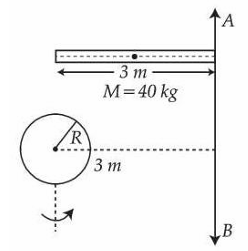 Moment of inertia about an axis for a rod of mass and length is same as that of a solid sphere of mass and radius about an axis parallel to axis with separation of as shown in figure. The value of is given as . The value of is _______.- A.
- B.
- C.
- D.
Show answer / उत्तर देखें
Answer: C
Moment of inertia of a uniform rod about an axis through its end is . By the Parallel Axis Theorem, the moment of inertia of the solid sphere at a distance is . . Given that the moments of inertia are equal: $4R^2 + 90 = 120 \implies 4R^2 = 30 \implies R^2 = \frac{3Q207 · Physics
In a screw gauge when the circular scale is given five complete rotations it moves linearly by mm. If the circular scale has divisions, the least count of screw gauge is _____ mm.- A.
- B.
- C.
- D.
Show answer / उत्तर देखें
Answer: D
The pitch of the screw gauge is the linear distance moved in one complete rotation. Pitch . The least count (LC) is given by the pitch divided by the total number of divisions on the circular scale. LC .Q208 · Physics
The increase in the pressure required to decrease the volume of water is . The percentage decrease in the volume is _____. (Bulk modulus of water .)- A.
- B.
- C.
- D.
Show answer / उत्तर देखें
Answer: B
The Bulk modulus is defined as the ratio of volume stress (increase in pressure) to volume strain (fractional decrease in volume): Rearranging for the fractional decrease in volume: Percentage decrease in volume .Q209 · Physics
Two nuclei of mass number combine with another nucleus of mass number to yield a nucleus of mass number . If the binding energy per nucleon for the mass numbers , and are MeV, MeV and MeV, respectively, then in the process, MeV.- A.
- B.
- C.
- D.
Show answer / उत्तर देखें
Answer: C
The reaction is: . The initial total binding energy is the sum of the binding energies of the reactants: . The final binding energy is the binding energy of the product: . The energy equivalent of the mass difference reflects the change in resQ210 · Physics
A solid sphere of mass and radius is divided into two unequal parts. The smaller part having mass is converted into a sphere of radius and the larger part is converted into a circular disc of thickness and radius . If is moment of inertia of a sphere having radius about an axis through its centre and is the moment of inertia of a disc about its diameter, the ratio of their moment of inertia .- A.
- B.
- C.
- D.
Show answer / उत्तर देखें
Answer: B
For the smaller part (mass ), forming a solid sphere: Since density is constant, volume is proportional to mass. . The moment of inertia of this smaller sphere about its center is: . The larger part has mass $m_2 = M - \frac{M}{8Q211 · Physics
Two projectiles are projected with the same initial velocities at the and with respect to the horizontal. The ratio of their ranges is . The value of is:- A.
- B.
- C.
- D.
Show answer / उत्तर देखें
Answer: B
The horizontal range of a projectile is given by . For the first projectile (): . For the second projectile (): . The ratio of their ranges is . Given the ratio is $1 : xQ212 · Physics
A slit of width is illuminated by light of wavelength . The linear separation between and minima in the diffraction pattern produced on a screen placed at a distance from the slit system is _____.- A.
- B.
- C.
- D.
Show answer / उत्तर देखें
Answer: C
In a single-slit diffraction pattern, the condition for the -th minimum is . For small angles, , so the linear position on the screen is . The position of the minimum () is . The position of the minimum () is . The linear separation between them is $y_3 - y_1 = 3 \frac{D\lambda}{a} - 1 \frac{D\lambdQ213 · Physics
A string of length m and Young's modulus is connected to another string of length and Young's modulus both twice of those of . This series combination of strings is then suspended from a rigid support and its free end is fixed to a load of mass kg. The net change in length of the combination is _____ mm. (radius of both the strings is mm and acceleration due to gravity ) (Mass of both strings is to be neglected as compared to the mass of load)- A.
- B.
- C.
- D.
Show answer / उत्तर देखें
Answer: B
For string : , . For string : , . The cross-sectional area for both is . The tension throughout the strings is . The elongation of string is: $\Delta L_A = \frac{T L_A}{S Y_A} = \frac{8 \times 0.314}{(4\pi \times 10^{-8}) \times (2 \times 10^{10})} = \frQ214 · Physics
An ideal gas undergoes a process maintaining relation between pressure and volume as , where and are constants. If two samples and (two moles each) with initial volumes and respectively undergo above mentioned process and attain same pressure, then the difference at the temperatures of these samples, is _____. ( gas constant)- A.
- B.
- C.
- D.
Show answer / उत्तर देखें
Answer: B
From the ideal gas law, . We are asked for the initial temperature difference based on their initial volumes along this path. For sample A with : . The initial temperature of A is . For sample B with : $P_B = P_o \left( 1 + \left(\frac{V_o}{3V_o}\right)^2 \right)^{-1} = P_o \left( 1Q215 · Physics
A voltmeter with internal resistance of can be used to measure upto V. In order to increase its measuring range to V, the required modification is to _____.- A.connect resistor of , in series with voltmeter.
- B.connect resistor of , in parallel to voltmeter.
- C.connect a resistor of in series with voltmeter.
- D.connect resistor of in parallel to voltmeter.
Show answer / उत्तर देखें
Answer: A connect resistor of , in series with voltmeter.
Let the maximum current the voltmeter can measure for full-scale deflection be . Initially, . To increase the measuring range to V, a multiplier resistor must be connected in series. The new voltage range equation is . . . Therefore, a resistor of must be connected in serieQ216 · Physics
An insulated wire is wound so that it forms a flat coil with turns. The radius of the innermost turn is cm, and of the outermost turn cm. If mA current flows in it then the magnetic moment will be . The value of is _____.- A.
- B.
- C.
- D.
Show answer / उत्तर देखें
Answer: B
The number of turns per unit radial length is . Consider a differential ring of radius and width . The number of turns in it is . The magnetic moment of this element is . Total magnetic moment $M = \int_{r_1}^{r_2} dM = \frac{\pi N I}{r_2 - r_1} \int_{r_1}^{r_2} r^2 dr = \frac{\pi N I}{r_2 - r_1} \left[ \frac{r^3}{3} \right]_{r_1}^{r_2} = \frac{\pi N I}{3} \frac{r_2^3 - r_1Q217 · Physics
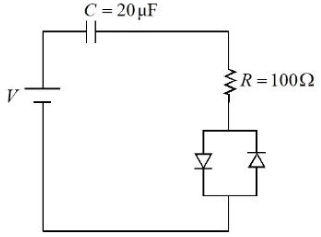 Consider a circuit consisting of a capacitor (), resistor () and two identical diodes as shown in figure. (A parallel combination of an upward and downward pointing diode, all in series with the R and C). The resistance of diode under forward biasing condition is . The time constant of the circuit is . The value of is _____- A.
- B.
- C.
- D.
Show answer / उत्तर देखें
Answer: A
The two diodes are in anti-parallel configuration. In either half-cycle of the AC source, exactly one diode is forward biased while the other is reverse biased (open circuit). Thus, the equivalent resistance of the diode pair at any time during conduction is purely the forward resistance of one diode, which is . The total effective resistance of the circuit in series with the capacitor is $R_{eq} = R_{\text{resistor}} + R_{\text{diode}} = 100 \text{ } \Omega + 10 \text{ } \OmQ218 · Physics
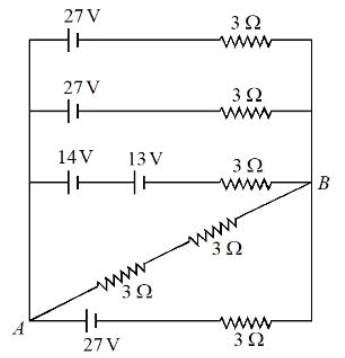 The voltage and the current between and points shown in the circuit are _____. (Note: Applying Thevenin's / Millman's simplification to the multi-branch network leads to an equivalent voltage and short circuit current).- A.
- B.
- C.
- D.
Show answer / उत्तर देखें
Answer: B
Based on interpreting the bridge and using the solution configuration: The circuit is simplified using Millman's theorem. Between an intermediate node structure (let's say C and D), we identify four parallel branches forming a source. Using , the equivalent voltage equates to when fully simplified across the terminals referenced as A and B. The Thevenin equivalent resistance across these terminals resolves to $6 \text{ } \OmegaQ219 · Physics
A telescope with objective diameter is used to observe a distant star emitting light of wavelength nm, at a resolution of radian. The value of is _____ cm.- A.
- B.
- C.
- D.
Show answer / उत्तर देखें
Answer: B
The angular resolution limit (Rayleigh's criterion) for a telescope is given by , where is the diameter of the objective lens. Here, the diameter is designated as . Rearranging for : . Substituting the given values: . Converting to cm: $R =Q220 · Physics
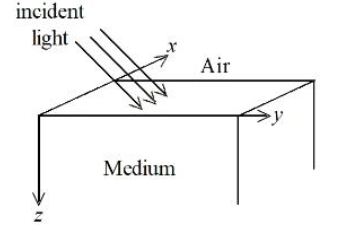 An unpolarized light is incident on the plane interface of air-dielectric medium shown in figure. If the incident angle is equal to Brewster angle, identify the expression representing reflected wave. (Given the plane of incidence corresponds to the x-z plane such that the reflected ray propagates towards and .)- A.
- B.
- C.
- D.
Show answer / उत्तर देखें
Answer: A
At Brewster's angle, the reflected light is completely plane-polarized perpendicular to the plane of incidence. Based on the physical representation, the incidence lies in the plane, and the reflected ray is traveling horizontally in and vertically upward in . The argument for propagation therefore is . The electric field must be perpendicular to this plane of incidence. The only perpendicular direction available is along the -axis. Thus, the eQ221 · Physics
A kg block subjected to two simultaneous forces N and N is moved a distance of m along direction. The work done in this process is _____ J.- A.
- B.
- C.
- D.
Show answer / उत्तर देखें
Answer: B
The net force acting on the block is the vector sum of the two forces: N. The displacement vector is along the direction of and has a magnitude of m. The unit vector in this direction is . The displacement vector is $\vec{d} = 25 \hat{u} = 25 \left(\frQ222 · Physics
The surface tension of a soap solution is N/m. The work required to increase the radius of a soap bubble from cm to cm is J. The value of is _____. ()- A.
- B.
- C.
- D.
Show answer / उत्तर देखें
Answer: A
Work done to expand a bubble is given by . A soap bubble has two surfaces (inner and outer), so the change in surface area is . Here, and . . . Work done $W = (3.5 \times 10^{-2}) \tQ223 · Physics
The velocity of a particle executing simple harmonic motion along x-axis is described as , where represents displacement. If the time period of motion is s, the value of is _____.- A.
- B.
- C.
- D.
Show answer / उत्तर देखें
Answer: B
The standard equation for velocity in Simple Harmonic Motion is . Comparing this with the given equation , we identify the coefficient of : . The time period is . We are given s. Setting these equal and using : $\frac{x}{7} = 2 \pi \implies \frac{x}{7} = 2 \left(\frac{22}{7}\right) \impQ224 · Physics
A body of mass kg begins to move under the influence of time dependent force N, where and are unit vectors along x and y-axis respectively. The power produced by the force at s is _____ W.- A.
- B.
- C.
- D.
Show answer / उत्तर देखें
Answer: B
Given the mass , the acceleration is: . The body begins to move from rest, so its initial velocity is zero. Integrating the acceleration gives velocity : . Power is the dot product of force and velocity: $P = \vec{F} \cdot \vec{v} = (2t\hat{i} + 6t^2\hat{j}) \cQ225 · Physics
An inductor of mH, capacitor of and a resistor of are connected in series across an a.c power supply V, Hz. The power factor of the given circuit is . The difference in the inductive reactance and capacitance reactance is . The value of is _____.- A.
- B.
- C.
- D.
Show answer / उत्तर देखें
Answer: B
The power factor of an LCR series circuit is given by . Given the power factor is and : . The impedance is also related to resistance and reactance by . Substituting the known values: $(X_L - X_C)^2 = 30000 \implies |X_L - X_C|